


Inflection
 Without getting too deep into Calculus (which is Greek on steroids to me), “Inflection” is a change point. It’s when we go from one direction into another.
For example, when we use inflection in our speech, we go from one way of speaking to another.
The piece we rarely focus on is the change point. The change automatically happens without us noticing the specific point at which we changed direction.
We usually find this point when doing some retrospection, but it’s of marginal use then because the change has already taken place.
If we notice the change point in real time, we have a much better chance of choosing whether we want to change or not.
What triggers your change? What takes you from glad to sad or vice-versa? What takes you from “in the pink” to needing a drink?
Begin to notice the triggers and you decrease your chances for getting shot. The triggers precede the change and take us to the point of inflection.
Here’s a simple test. Is there a word or phrase that hooks you every time into a less than resourceful frame of mind? That’s a trigger. But notice that the word or phrase has no power on its own to cause change; it’s the meaning that you’ve attached to it that fuels the change.
You have done some pre-conditioning algebra that X=Y. If X always equals Y, you are at the mercy of a debilitating equation. The inflection point is noticing and acting on your response to X before it becomes Y.
You have to do this more than once to reap the benefits. It takes practice to get unhooked from a trigger. This practice has application well past outgrowing your response to a word or phrase.
What triggers your recurring bad mood, a downward health cycle or a spat with your partner or spouse? You’ll never eliminate the triggers but you can notice them, and you won’t pull them as often if you act at the inflection point.
A good place to start is noticing your speech. One word to be on the lookout for is “Always.” “I always get a cold at the beginning of spring.” “She always makes me mad when she says that.” “I always get irritable just before I have my period.” These are all X=Y statements and left unchecked lead to self fulfilling prophecies.
One great way to outgrow these equations is a phrase I learned from the legendary hypnotist, Dr. Dave Dobson. The phrase is “in the past.”
“In the past, I always got a cold in spring.” “In the past, I got angry when she said that.” “In the past, I got irritable before my period.”
Referencing something as “in the past,” suggests to your mind that it’s not happening now. When the trigger fires, the inflection phrase “in the past” or its second cousin, “up until now,” changes the equation from always being true in the past to one of many possibilities now.
I request that you engage your curiosity and start noticing what triggers your automatic behavior and then apply some “in the past” reflection to the point of inflection.
All the best,
John
VIRTUAL MASSAGEBe Sociable, Share!
 There was a big hit song in the 1970s called “
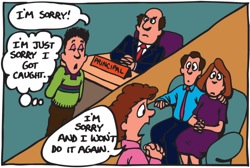 Last week The Grasshopper offered this: “Apologize for what you’re sorry for.”
 The Grasshopper offered a profound piece of wisdom the other day: “It doesn’t matter if you’re right if you present it wrong.”
 Here we are in the month of November which contains my favorite holiday – Thanksgiving. We are all encouraged to give thanks during this time of family gatherings, fantastic food and festivity. It got me to wondering about gratitude and how we laser focus on it during this special time.
 Lots of folks intend. In many circles, intending would be called praying. You would think that we would give up on a practice that has worse odds than
  Question: Are you happy with your own company? This isn’t a business question.
 It dawned on me that there are traditions worth holding on to and those that would be useful to outgrow. How do you tell the difference?
 Back in my radio days, we used to have a feature called “Battle of the Bands.” We would play two songs and ask you to call in and vote for which one you liked better. Then the winner of that round would compete against another song. After several rounds, we would declare the song left standing as the winner.
 One of the best lessons I’ve learned so far is about fluidity. “Go with the Flow” fits well on a bumper sticker or motivational poster but like most platitudes, it lacks direction.