
GrasshopperNotes.com - Thoughts for inspired living


October 16, 2014

Without Evidence

Filed under: John Morgan's Blog — John Morgan @ 6:43 am

Evidence BagI am truly stunned when I contemplate the things I believe without evidence. What is equally stunning is the penchant to argue for those beliefs. It can lead to a lifetime of arguments that never get resolved.

When we argue for our beliefs, we are arguing for our conditioning. After all, we weren’t born with any beliefs. Our beliefs, for the most part, were someone else’s beliefs passed on to us without our permission. We believed in (fill in the blank) before we even knew what a belief was.

Some people can make a good argument for their beliefs because they include some evidence, but notice that they often leave out any available evidence to the contrary.

Then there is the “True Believer.” That’s the person with no evidence at all. You would encounter more facts if you argued with a turnip.

I have more respect for someone who says, “I have no convincing evidence to back this up, but this is what I believe,” than I have for someone who espouses a belief with an anemically weak argument.

Just look at the amount of unprovable drivel some of your Facebook friends pass on without evidence just because someone they like said it.

We’re not going to stop believing anytime soon but I wonder how many less arguments we would engage in if we began to examine our beliefs.

What we will find is a bevy of unsubstantiated grist for the argument mill.

If you truly believe in something, make it your mission to find the evidence, rather than arguing for the rest of your life about something you have an opinion about.

It really comes down to this: Do you want to set up arguments and foment contention for the rest of your days? If so, become a talk show host. If not, stop arguing for your limitations – which are your beliefs without evidence.

All the best,

John


Be Sociable, Share!


October 15, 2014

Ineffective Communication

Filed under: John Morgan's Blog — John Morgan @ 6:29 am

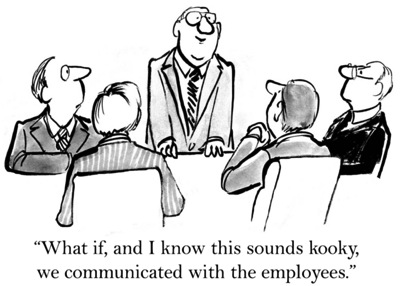
C765917 m

The Grasshopper defined “Ineffective Communication” for me the other day: “Asking questions you’re not invested in.

After I forgave him for ending a sentence in a preposition, I began to inspect how often I ask without investment. What I found was that each time I did, I was not reaching the person.

“How are you doing in school?” That could be near the top of the list unless you’re a guidance counselor. If you said nothing, you’d communicate more than you do with that kind of question.

“How was your day?” is also quite disingenuous. If that’s as curious as you are about someone, you’re just asking to ask.

Have genuine curiosity when you ask a question and you will reach the person more often than not. And ask with specificity. “I know you had a meeting with the doctor today. What did she say about your shoulder?”

I wrote a blog post in 2009 titled “Small Talk” which approaches the topic from a different angle. The opening sentence from the post is worth restating: “It seems as though it’s the currency of connection but, in the long haul, it’s Monopoly money – Small Talk.”

We need to play a much bigger game if we wish to reach another person.

It begins with investing yourself in a question. Have a stake in the interaction and you’re more likely to get a dividend.

Without investment, you’ll remain a poor communicator.

All the best,

John


Be Sociable, Share!

October 9, 2014

Mistakes

Filed under: John Morgan's Blog — John Morgan @ 11:05 pm

C166813 mI find the phrase, “You learn from your mistakes” to be incomplete and mostly inaccurate. The Grasshopper brought me new perspective yesterday when he said, “You learn from the mistakes you notice.”

I know I’ve quoted my brother-in-law before who was in the insurance industry. He said many of the people he worked with had been in the profession 25 years but kept repeating their first year over and over. They didn’t learn from their mistakes; they repeated them.

If you don’t realize you are making a mistake, your chances for correcting it are astronomically low.

To make our chances even lower, some of us won’t correct our mistakes, not because we don’t notice them, but because we are in denial about them. You’ve heard the phrase “an accident waiting to happen.” With the addition of denial, it’s more about waiting for an excuse to be issued.

Seems to me there is a direct correlation between the number of excuses issued to the number of mistakes made.

Perhaps to lessen the number of mistakes we make, it would be more beneficial to notice how often we make excuses. The formula is simple: Less excuses = Less mistakes.

So rather than taking mistakes head-on, it may be more productive to go through the back door and remove the excuses. The excuses are the glue that keep both denial and mistakes in place.

Once the bonding capability of an excuse is gone, denials get weaker and mistakes are more easily noticed.

Start noticing your excuses and, before too long, you won’t be asking as often to be excused for your mistakes.

All the best,

John


Be Sociable, Share!


October 8, 2014

Stage “Wrong”

Filed under: John Morgan's Blog — John Morgan @ 2:04 am

C592339 mI’m not big on “right” and “wrong.” I much prefer “works” or “doesn’t work.”

Our actions in life are often labeled “right” or “wrong” and from my experience, that only sets up a debate. When you objectively observe whether your actions are working or not, you have outlined a path forward, rather than entrench yourself in a defensive position of right or wrong.

Language matters. We have been conditioned to certain words that trigger specific sensations. Unless we recognize the conditioning and take steps to outgrow it, we are at the mercy of our language.

Notice your response to these phrases:

“You’re bringing up your children wrong.”

“You didn’t handle that the right way.”

“You’re doing it all wrong.”

“Right” and “wrong” will close you down in a heartbeat. You will also put others on the defensive when you assert right and wrong.

I have this notion that there is too much “kid gloving” going on in the world. “Kid gloving” means that we make excuses for behavior (ours or another’s) that’s not working. My conditioning says making excuses is wrong, but if I don’t challenge my wording, I have little chance of getting it “right” – meaning “getting it to work.”

I invite you to notice how many times you invite right or wrong into your conversations. The more often you do, the more often the conversations will go round and round as each of you circles the wagons.

We set the stage for a forward direction in our life’s play when we rewrite the dialogue and intentionally let the words “right” and wrong” fade away.

All the best,

John


Be Sociable, Share!


October 2, 2014

Sense of Selves

Filed under: John Morgan's Blog — John Morgan @ 7:42 am

C395251 mMost of us can cite change points in our lives. For me, it was the discovery of “I” and “Me.”

It dawned on me that there were two selves – I and Me.

Me only thought there was me. Me is the outer self, the one we talk to ourselves about inside our head. Me is a collection of life’s experiences. To quote Czech writer Milan Kundera, “What is the self? It is the sum of everything we remember.”

The outer self is our self image. “Yep, that’s me.”

What I found out about being me is that there is built in exclusion of other ways, especially ones different from mine. Me takes on the mantle of “the way me thinks is the way it is.”

“I” doesn’t think. “I” observes.

When I discovered there was a thinker and an observer, I began to think less and observe more. One of the things I began to observe was my thinking. It was eye-opening.

I found out there is a part of me that thinks that the only thing there is is thoughts. When I found out I could observe the things I thought were the only things, I found my inner self – the observer.

The observer frees you from your thoughts. You begin to notice these tightly compacted thoughts that pretend they are the only way it is and, like magic, these thoughts begin to unravel. Old beliefs begin to fall apart because there isn’t the glue of thinking to hold them together.

Me takes on a life of its own, never noticing that I is there, until it does.

The way to “I” is to observe “Me.” It’s the observation of this ongoing train of thought that brings you to the whistle stop known as “I.” It’s there that you can hop off and observe rather than pretend to know how things are.

You’ll know you are ready to break out of the cocoon of “Me,” when you observe that there are other ways it can be.

All the best,

John


Be Sociable, Share!


September 29, 2014

Waiting for Life to Happen

Filed under: John Morgan's Blog — John Morgan @ 7:27 am

Energizer bunnyThis would be a great title for a book – “Waiting for Life to Happen.”

It would be a best seller because most of us are afflicted with the waiting disease and are hell-bent on finding a cure.

We don’t wait with the patience of Job but rather with the frenetic action of the “Energizer” bunny.

Waiting is our video game of choice and we play it all the time.

Here’s one of life’s secrets: Waiting produces more waiting.

To be more precise with the book title, we are waiting for a preferred “slice” of life to happen, rather than life itself. Life is happening all the time in every moment, so no waiting is necessary.

The waiting we do is for something that has really low odds of happening – winning the lottery, being discovered, and a whole host of other pipe dreams that suggest we don’t have to work at them.

“I’ll do this until what I really want to do comes along” is the silent agenda of the waiter. Here’s a clue: It’s not coming along.

The waiter has more starts and stops than a New York City bus. They build up a head of steam for a city block and then come to a screeching halt. They repeat this pattern for a lifetime. They haven’t learned the lesson of sustained effort. Anyone who is living life now and not waiting for it to happen is progressively working at making something happen.

The missing piece of most plans is “doing.” Living life is doing because life is always moving forward and if you are not moving with it, you are left behind, waiting.

Yes, there is plenty of reflecting that goes on with someone living life. That quiet time is the “pause that refreshes” to quote an old soft drink commercial.

When you constantly wait, your body gets used to inertia and it’s harder to feel the life that’s always coursing through your veins. Look at someone living life and you can see a palpable energy moving them along.

Waiting for life to happen is suicide on the installment plan.

The good news is this: There is a cure for waiting – it’s doing. If you’re waiting for doing to come along, you’ve missed the point. Doing, like life, is always present. Doing is not on a waiting list. Doing is happening now. You just have to tap into its energy and let it propel you along.

Waiting for life to happen? It’ll be a long wait. Doing is the catalyst that makes life happen. If it’s not happening for you, may I strongly suggest “Do.”

All the best,

John


Be Sociable, Share!


September 22, 2014

Fix or Resolve

Filed under: John Morgan's Blog — John Morgan @ 6:19 am

ImagesIt occurred to me over the weekend that the words “fix” and “resolve” are often used interchangeably but often mean different things.

“Let’s fix the bike tire” is pretty clear cut. “Let’s resolve this ongoing issue” takes us in a different direction.

“Fix” implies getting it back to the way it was working; resolve may have you come to the conclusion that it may never work that way again.

“Fixes” are often short fixes, especially in relationships. You fix it until the next time it happens. Too many short fixes suggest that you need to resolve that which needs constant fixing.

To me, resolving is a longer term fix.

Resolving means moving past the short fixes to something that has more lasting power. Resolving may also mean it’s time to move on.

“Kiss and make up” is a staple in our culture, whether in personal or professional situations. Where it becomes counterproductive is when the bulk of your time is spent making up rather than making plans for what will work long-term.

We all get into fixes and the short-term solution often works fine. “My water heater just broke. Can you lend me the money to fix it? My tax refund is due next week and I can pay you back then.”

Contrast that with the person who asks you to borrow $20 every Monday and says they will pay you back on Friday on pay day. You no longer have access to your money for four days every week. That’s an ongoing situation that needs to be resolved, not fixed.

Final thought: If you’re constantly in a fix, you would be best served to find some resolve, otherwise you’ll be forever pedaling on flat tires.

All the best,

John


Be Sociable, Share!


September 19, 2014

Their Way

Filed under: John Morgan's Blog — John Morgan @ 5:39 am

C455270 mI wonder how many people will come upon their twilight years and sing, “I did it their way.”
Frank Sinatra would turn over in his grave.

There is only so much “go along to get along” a person can take before it takes its toll.

There has to be something in it for you otherwise you’ll end up in a perpetual stew.

I’m not addressing “my way or the highway” here; just strongly suggesting that you lay claim to the notion that you’re important enough not to be impotent.

Helplessness is only conditioning; you weren’t born with it. At some point you will have to make a choice to recondition yourself or resign yourself to do it their way.

This isn’t about rebellion; it’s more about waking up from sleepwalking down someone else’s path.

Begin to get curious about your path. Just opening your eyes to the idea that there is another way takes you a step closer to your way.

Be willing to entertain the concept that there is a way for you. You don’t have to “figure it out” – just be open to the idea that there is a way for you. It’s this willingness to be open that wakes you up to open doors.

My claim is that discoveries are really “uncoveries.” That means they’ve been there all along, just covered over. Your way has been there all along too; you just have to wipe the sleep out of your eyes to see it.

Be willing to be open to your way. Before long, this mindset will have you singing a different tune.

All the best,

John


Be Sociable, Share!


September 16, 2014

Care to Remember

Filed under: John Morgan's Blog — John Morgan @ 5:45 am

C284071 mThis is just a little slice of life that happened last night that tickled me.
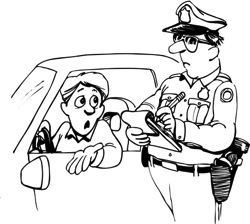
I was involved in a rare event – a conversation with my grandson. He attended a wedding over the weekend and I was asking him about his experience. He went on to tell me about the people he met and some of the local flavor he encountered out on Cape Cod.

I then asked about an incident I had heard about that happened and was looking for a bit more detail. I said, ” I heard that _____________ gave you some shit (verbal abuse).” He looked at me quizzically and said, “Maybe you’re referring to . . .” (an innocuous comment that this person made).

He then said, “If it’s anything other than that, I don’t remember.” He then went on to hit me with the quote worth re-quoting: “If I don’t care what you are saying, I’m not going to remember it.”

It caused me to come up with a new version of the old schoolyard ditty that we’ve all learned.

“Sticks and stones will break my bones but names will never hurt me, especially if I don’t care enough to remember them.”

Thanks, grandson. You can teach an old dog new tricks.

All the best,

John


Be Sociable, Share!


September 3, 2014

Beware of Because

Filed under: John Morgan's Blog — John Morgan @ 6:34 am

C266600 mIf there’s a more used word than “because” to defend our limitations, I’m unaware of it.

We divert attention away from a solution when we defend our or anyone else’s actions with “because.”

How often have you heard or said some form of this sentence: “I’m/He’s/She’s this way because . . .”?

“Because” will send you off into the land of illusion. If you put a period after the word “way,” you are now looking at the unfiltered reality and are better positioned to seek a solution.

Here’s my favorite: “He drinks too much because he’s an alcoholic.” What’s the real issue here? The answer is: “He drinks too much.” Notice the period after the sentence.

“My son is acting out because I’m having problems with my ex.” Begin to notice the trip to Never-Never Land that follows “because.”

“Because” keeps you focused on the reasons things are the way they are. You’ll never run out of reasons. If you don’t believe that, just ask a high school freshman why they’re failing Algebra. “Because all the kids are failing.” “Because the teacher doesn’t like me.” “Because our textbook is outdated.” The list could go on forever if you let it.

“Because” will not lead you to a solution. Reminds me of a story I may have told before . . . Back in my radio daze I had a DJ who worked for me who was not paying attention one day while on the air. There were a couple of occasions of “dead air.” That means the song he was playing was over and he didn’t notice the on-air silence because he was talking on the phone. Dead air has happened to every broadcaster in their career. It’s usually the rare exception. On this day, it happened twice in 10 minutes.

After his show was over, I invited him in for a chat. I said, “You had dead air twice in 10 minutes on your show today.” What he said next astounded and amused me at the same time. He told me that his doctor diagnosed him with ADD and that’s the reason he was having a problem concentrating.

I said, “Let me ask you a question off the topic. How are things going with your new girlfriend?” He said that everything was fine and, in fact, they had moved in together. I then asked, “This is none of my business but do you have any concentration issues when making love with her?” He laughed and said that everything was fine in that department.

I then told him that ADD wasn’t selective and he needed to pay more attention to his show. The instances of dead air immediately ceased.

Beware of the breadcrumb trail of “because.” It will lead you away from the issue that needs addressing and into the abyss of excuse.

All the best,

John


Be Sociable, Share!


« Previous PageNext Page »