GrasshopperNotes.com - Thoughts for inspired living


April 8, 2015

Peevish People

Filed under: John Morgan's Blog — John Morgan @ 6:54 am

C475183 mRather than list a bunch of pet peeves, I decided to go one step further and list the people who perform these acts as “people I don’t want to know.”

This isn’t an exhaustive list but could easily serve as the Top 10 of PEOPLE I DON’T WANT TO KNOW.

I don’t want to know you if . . .

1. You leave your grocery cart in the parking lot right next to your car and then pull away. What I pray is that someone else who does the same thing leaves their carriage near your car on a windy day.

2. You yell at your spouse/lover/significant other in public.

3. You list all the medications you are taking and want to talk about them.

4. You go door-to-door pedaling your religion.

5. You invented the Robocall.

6. You don’t flush toilets.

7. Your favorite movie is Rocky V.

8. You constantly argue for your limitations.

9. You drive in the passing lane at the speed limit.

10. You tell me you know how I feel.

I’m sure I missed a few, so don’t be shy and add some of yours to the list.

I’m guessing this listing says more about me and my prejudices than it does about the people who perform these acts. Either way, If you’re one of these folks, please don’t ask me to come out and play.

All the best,

John


Be Sociable, Share!


April 7, 2015

One Sentence

Filed under: John Morgan's Blog — John Morgan @ 7:16 am

C785853 mI was watching a video yesterday about the future of photography. In there this person says that in the context of your work, you can be reduced to one sentence: Oh, he’s the guy that does (blah, blah).”

It occurred to me that this reductionism happens in life as well. “Oh, she’s the one who always complains.” “Oh, he’s the one with permanent rose colored contact lenses.” The descriptions can be as creative as you like but most of us can be reduced to a sentence – some positive, some negative.

The one sentence description is about the surface us – the persona we’ve adopted to interact with the world. What a limiting description.

Our depth cannot be described in a sentence; in fact, it can’t be described at all because it’s a feeling. I don’t know about you but I have yet to discover the collection of words that can describe a feeling.

Getting to your depth means getting past your labels. Your label is like the sticker on a box pretending to be the content of the box. You are not your label.

Perhaps you have a one sentence description of yourself. I submit that when you find it, you have found your limitation. Labels are limiting and take you in another direction besides depth.

Start noticing your descriptions of yourself. “Oh, I’m a person who . . .” Notice that your one sentence is a limitation and begin the process of not labeling yourself. Catch yourself in mid sentence and change course.

One phrase that will help you change course is one I learned about 25 years ago. It’s called, “In the past.” “In the past, I was a person who . . .” Once you notice you’re giving a limiting description of yourself, interrupt yourself and say, “in the past.” “I’m a person who’s always late” becomes “I’m a person who’s always (pause); In the past, I was a person who was always late.”

This interruption opens you up to options and the more options you discover, the more depth you’ll experience.

So if you’re hellbent on describing yourself, here’s a recommendation for a one sentence description that will lead you to more depth: “I’m a person who seeks more options.”

All the best,

John


Be Sociable, Share!


April 3, 2015

Paying for Mistakes

Filed under: John Morgan's Blog — John Morgan @ 5:26 am

Pied piper jpgThe Grasshopper was channeling Captain Obvious the other night when he said, “Not paying for a mistake makes it more likely to happen again.”

If you haven’t yet paid a price for a mistake, you will get several more opportunities because the inevitable repetitions will set off an alarm at the piper’s house. (Cue the overused cliché: “Karma is a Bitch”).

If you have skated by, unscathed, up to this point, don’t be doing, as my mother used to say, “a fan dance” because the music will run out and there won’t be a chair for you.

The ideal remedy for avoiding future mistakes is to notice them before they happen again. That rarely happens. We usually aren’t aware until the mistake has happened again. The key is to notice the mistake while it’s happening, so you can correct it in midstream and have a better chance of not drowning in your own do-do.

“Paying” in this context is paying attention.

We all know what our mistakes have been and we’ve all knowingly repeated them. If you would like to get out from under a specific mistake start paying attention. That means you have to get off of auto pilot.

How many times have you had the same argument with someone? It goes the same place each time. You can avoid the mistake of arguing with them again by avoiding them but, that’s just not practical.

The next time the argument scenario comes up (yes, it will come up again), pay attention to how you are about to automatically react and just wait until that reaction passes by and select a different response. There are other responses waiting in line but we, in the past, have automatically selected our first one which causes us to respond in kind, which is anything but.

Start paying attention to how you respond. You have no say in what another person will say or do but you have the ability to notice what’s about to come out of you. Just noticing yourself about to go into reaction mode is often enough of a wedge to keep you from making a familiar mistake.

Noticing will trigger a bevy of other responses just waiting for their chance to come out and play, keeping the piper and his collection purse looking elsewhere for mistakes that pay.

All the best,

John


Be Sociable, Share!


April 2, 2015

Out of Focus

Filed under: John Morgan's Blog — John Morgan @ 6:28 am

Untitled 1I was talking about photography on the phone yesterday when the Grasshopper snapped in and said, “You can’t focus on what you can’t see.” My chat partner said, “Wow, what a metaphor.”

When you’re in the dark about something, it’s truly hard to focus. Someone may offer you their most sage piece of advice but it won’t click if you remain in the darkroom.

What keeps us from seeing? Blinders, of course.

Blinders are learned attitudes and beliefs that haven’t seen the light of day.

I just watched the HBO documentary on Scientology. If you want to view some beliefs that become exposed when light is shined upon them, then you’ll benefit from watching.

We all have as many unsubstantiated and obtuse beliefs as the documentary shows about Scientology, but we rarely bring them out of the dark for inspection.

We certainly believe in things we can’t see, like the wind or gravity, but we can verify their results. That’s not the case with most of our beliefs.

Light is the tool of verification. Have the chutzpah to bring something you believe into the light and focus on it sharply. Then you’ll be able to see details that were missing while they stayed in the dark.

Don’t defend your beliefs if you can’t verify them. You can certainly hold on to them but defending them just makes you look silly. I’ve quoted my sage, hypnosis teacher Dave Dobson on this before but it bears repeating. Dr. Dave said, “Theory is bullshit and defending your theory is bullshit squared.” Just substitute “belief” for “theory” and you’ll get the same result.

Muster the courage to expose your beliefs to the light of day where you can focus on them, and you’re likely to see something new develop.

All the best,

John


Be Sociable, Share!


March 30, 2015

The Energy of Now

Filed under: John Morgan's Blog — John Morgan @ 6:47 am

C562136 mHave you ever asked yourself, “What am I doing with my life?” The Grasshopper offered this answer to the question: “Whatever you’re doing now is what you’re doing with your life.

The real question is: What are you doing with the energy of your life?
Your energy is only present right now. It’s not in the past or in the future; it’s only here now. So whatever you’re doing with your energy right now is what you’re doing with your life.

Are you fretting now? Then that’s what you’re doing with your life. Are you working towards a goal right now? Then that’s what you’re doing with your life.

The question can be accurately answered in each moment by noticing what you’re doing in that moment.

“I’m not spending enough time with my kids or on my job or hobby or with my spouse or lover” are declarations about not living the life you want. Rather than listing what you’re not doing with your life, start now by doing any of those things; then you’ll be able to confidently declare: “I’m doing what I want with my life.”

Life only happens now. Please read that sentence again. Whatever you are doing now is what you’re doing with your life.

Start using the energy of now to do what you want rather than wasting your energy citing what you don’t want. You already know what you don’t want. Reminding yourself over and over is as silly as saying your name repeatedly to yourself so you won’t forget it.

The energy of now can be used in any fashion you choose. Channel your life’s energy towards doing what you want to do and do it now!

You don’t have to climb a mountain in a day. Use the energy of now to step in the direction of the climb. Then you can answer the age old question with “I’m stepping in the direction of doing what I want now.”

You have to step out of your head to take the first step. So stop philosophizing about the why and wherefore of what isn’t happening and start noticing what is. Then you’ll have a handle on what you’re doing with your life and if it needs adjustment, use the energy of now to take the first step in that direction.

Life only happens now. So here’s a new question: What are you doing with the energy of now?

All the best,

John


Be Sociable, Share!


March 25, 2015

Irrelevant Past

Filed under: John Morgan's Blog — John Morgan @ 6:45 am

C887532 mThe Grasshopper offered an early springtime blossom this morning: “It’s irrelevant how you felt then; it’s only relevant how you feel now.”

“I felt so betrayed.”

“I felt so helpless.”

“I felt so angry.”

Notice how all those phrases are in the past tense and notice how they drag you into the past.

Some therapists make their living by inviting these phrases. Is it any wonder that people who remain in therapy for years don’t show any appreciable forward movement.

The past tense keeps you in the past.

Notice your past tense language and you’ll get a handle on how you keep yourself there.

For many, the past is kept alive even though it’s dead and buried. Digging up the corpse again isn’t going to breathe life into your life. It has never worked and never will work but that doesn’t keep us from a steady diet of repasting on the past. Here’s the rub: Even the memory of a wonderful dinner won’t sate your appetite now.

What are your feelings now?

If you examine your situation closely, you’re not “betrayed,” “helpless” or “angry” now; you only get those feelings when you entertain how you felt then. I call that “feeling bad on purpose.”

What’s the purpose? It’s certainly not going to project you forward.

I request that you start monitoring your language and see how much of it is in the past tense. The more you start to focus on now, the more you begin to move on.

What’s going on now is your life; what was going on then may be the death of you if you keep it alive. The key to feeling less tense is to change your past tense.

All the best,

John


Be Sociable, Share!


March 20, 2015

The Demon of Denial

Filed under: John Morgan's Blog — John Morgan @ 4:48 am

C695710 mI think everyone can admit to having a demon or two but my sense is that none is more limiting than the Demon of Denial.

We all deny and I’m sure I’m not the first to recognize that “deny” does more than rhyme with “lie”; they’re interchangable.

So what’s the big lie that we deny? It’s that we had anything to do with our current lot in life.

As long as we deny that we’re not part of the problem, the solution lies out there somewhere.

I’m reminded of the Byron Katie quote from her book Loving What Is: Four Questions That Can Change Your Life: “As long as you think that the cause of your problem is “out there”—as long as you think that anyone or anything is responsible for your suffering—the situation is hopeless. It means that you are forever in the role of victim, that you’re suffering in paradise.”

The problem and the solution are not anywhere but where you are now. You’ll avoid the solution as long as you contend that what’s going on with you has nothing to do with what you’ve done. That’s the Demon of Denial in full costume.

Notice how quickly we accept responsibility for something that came out smelling like a rose but are quick to abdicate our part in a situation that smells like an elephant fart.

The elephant in the room is the Demon of Denial.

Talk with any AA counselor and you’ll find their hardest job is to get an alcohol abuser past the denial that alcohol is interfering with the quality of their life. The same is true with abusers of all sorts. If you abuse your body with any sort of overconsumption and deny you had anything to do with the results, your demon has taken you over and your situation remains as Katie says, “hopeless.”

The only hope you have to getting to a solution is to dissolve your denial.

That starts with the bold notion that we play a part in everything that goes on in our life. Have you ever been fired from a job? Notice that the last line you’ll utter is, “It was my fault.”

Did you play any part in your dismissal? Divorce? Disease? Or detriment of any sort? if you answered “no,” it will remain problematic and an unsolved mystery to you.

When we remove ourselves from cause and effect, the effect is denial – a demon that keeps us in place.

Pretend you are an actor who had a cameo role in a bad movie but repeatedly deny, to whomever will listen, that you were ever in it. The evidence is there for anyone to see except those still hanging on to denial.

When you admit that you’re part of the problem, the weight of the problem lessens and the search for a solution begins. You’ll never take the first step towards a solution until you get the devil to stop denying the details.

All the best,

John


Be Sociable, Share!


March 11, 2015

Grudge Match

Filed under: John Morgan's Blog — John Morgan @ 4:52 am

GrudgeThe Grasshopper woke me up with this: “All your grudges die when you do.”

Wow! No more grudges! “But do I have to die for them to die?” was my question.

The answer is “yes” and “no.”

Yes, the energy has to leave our body to die but, no, we don’t have to physically die for the energy to leave a grudge.

Letting a grudge lose its energy will take more than a declaration on your part, but it’s a start. Recognizing that a grudge zaps more energy from you than does digesting Thanksgiving dinner is reason enough to craft a plan for its demise.

Recognizing that your grudge is hurting you more than whomever you’re holding it against is helpful in getting you started on the process. You gain extra credit if you notice that the grudge you’re holding is against someone who’s already dead. When that becomes “laugh out loud funny” to you, you know your grudge is at death’s door.

I don’t have a step-by-step method to offer but I do have one exercise that’s worth practicing. I call it a “Grudge Match.”

You can physically do this exercise or just do it in your imagination. It will have an effect either way.

Write down your grudge on a small piece of paper or draw a picture or symbol that represents your grudge. Next, go to a nearby sink and set fire to the paper and watch what was burning you up, burn up. If you’re afraid of setting the house on fire, do it in your imagination. Again, either way has an effect.

The flames represent the energy necessary to keep the grudge alive. As you watch them die out, your grudge begins to move to the great beyond.

You can be lectured from here to eternity about the sinfulness and ill effects of grudges but that hasn’t worked on you so far, so I offer one little match that has more burning power than Mrs. O’Leary’s Cow.

You’ll probably have to do this exercise more than once to get a lasting effect but the results are to die for.

All the best,

John


Be Sociable, Share!


March 10, 2015

Subtraction or Contraction?

Filed under: John Morgan's Blog — John Morgan @ 1:15 am

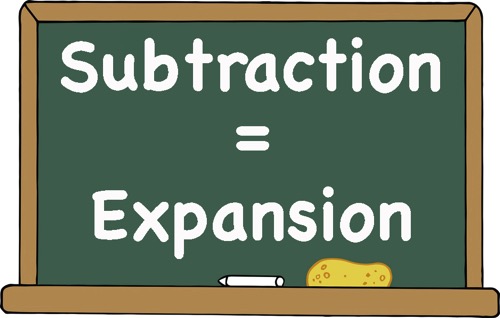
Subtraction = expansionI have this notion that life is about addition and subtraction. The first portion of our life is a process of adding things we believe we need to succeed in life. The second portion is about subtracting the superfluous – the bright and shiny things we found we didn’t need.

“Things,” in this context, is a broad concept that includes ideas and beliefs.

What I find that many people are doing in the subtracting phase is contracting instead. That means they are withdrawing rather than expanding.

Many contract into their life-long prejudices rather than subtracting them. Others contract into their ethnicity, race, religion or ideologic view rather than pursue a more ecumenical world view.

When you contract, you withdraw from the world and create an exclusionary one of your own.

Contraction, based on my observances over the years, causes physical contraction in your body. It doesn’t surprise me that people who have been described as “tight” (rhymes with right) wind up with crippling arthritis or constriction of blood vessels causing circulation and heart problems – long before the rest of the population.

While arguing to be right, they continue to contract and add to their physical misery.

It’s not necessary for these people to have a wholesale change of opinion, just a bit of a subtraction process that demonstrates to them that their opinion doesn’t matter. By subtracting, they find out who they are without their opinions. This causes expansion.

There is an expansion within their bodies as well. I’ve seen it too many times to deny that expansion gets people healthier and, dare I say, happier.

“Don’t sweat the small stuff because it’s all small stuff” is a great mantra for those seeking expansion. Life will go on when your constricting opinions die with you. Look at anyone you deem to be “really old and healthy” and notice that they aren’t contracting. They’ve just subtracted what doesn’t really matter.

All the best,

John


Be Sociable, Share!


March 4, 2015

Global or Local?

Filed under: John Morgan's Blog — John Morgan @ 7:55 am

C309825 mMost of us have been exposed to the notion of taking care of our little corner of the world as being our contribution to the globe. I wonder how it works in reverse.

What happens when you think globally? My sense is that doing so expands your options.

This is not a “Save the Planet” post, just a suggestion that considering the whole expands your little corner of the world.

What is the whole? I’m not quite sure but I know it contains all the tiny corners.

A circle has 360 degrees. Let’s pretend the circle represents the whole and each one of its 360 degrees represents a part. How often do we stand on the same degree mark and interpret the world from there? There are 359 other angles of approach but we stay stuck on one.

The more we move ourselves around the circle and view our world from different angles, the more global we get.

This global strategy can be experienced by putting into practice the title of an old song: Walk A Mile In My Shoes.”

It seems to me that “Hooray for our Side” is at epidemic proportions. That’s local and limiting. It doesn’t matter what the topic, the more you stay local, the more you stay in conflict, and we justify that stance by clamoring that we are right.

We remain in a constant state of conflict when we stay stuck in our own little world. Just shift your position a degree or two and find out for yourself that global options mean less war for you.

All the best,

John


Be Sociable, Share!

« Previous PageNext Page »