
GrasshopperNotes.com - Thoughts for inspired living


September 20, 2013

Needy

Filed under: John Morgan's Blog — John Morgan @ 5:57 am

C349613 mThe Grasshopper must love taking walks because he delivered this gem the other day during one: “When seeking help, bring your needs, not your neediness.”

What you need and what you are needy about travel on different paths. One goes towards the light of help and the other goes nowhere.

Neediness, pure and simple, is the lack of resourcefulness. A person who genuinely needs something lets what’s on the periphery go out of focus and zeros in on that specific need. Resources now have a direction to flow. The needy person is like a novice photographer at a wedding who takes thousands of pictures in rapid fire succession hoping to get some that look good. That’s called “Spray and Pray.”

Neediness contains a deep sense of lack – a lack of resources.

Neediness is a perception that doesn’t look in the direction of resources; it only focuses on lack. Looking into an empty pit is not going to fill up the hole. Looking for resources is your best option.

The needy person doesn’t think much of themselves because they are blind to their internal resources. They don’t think there’s enough of whatever it is they need. People needy about money don’t think there’s enough money to go around when, in fact, there’s more than enough. It’s what the parable of the loaves and fishes addresses.

A needy person is looking for someone else to provide for their needs when they are the own best provider. Dr. Dave Dobson made the bold claim that we are our own best therapist. He wasn’t suggesting that people not seek help; he was suggesting that they check in before they assume that what they need is out there somewhere.

You are resourceful; you just have to get focused on that part of you rather than staying glued to being needy.

Neediness is a repellent. No one wants to help a needy person because they know it’s a bottomless pit and a forever commitment – Translation: A drain.

If you are always looking for a helping hand, you’ll never handle your difficulties. That’s called not growing up. Growing up is recognizing your own resources and fashioning solutions.

When you become resourceful, that’s when you’ll discover willing people willing to lend a hand. I guess this whole post could be written more succinctly by quoting an ancient proverb: “God helps those who help themselves.”

All the best,

John


Be Sociable, Share!

September 16, 2013

What Am I Responsible For?

Filed under: John Morgan's Blog — John Morgan @ 8:00 am

C166384 mThe Grasshopper offered this observation the other day: “You’re not responsible for your thoughts and feelings; you are responsible for your actions.”

How often have you beaten yourself up for your thoughts or feelings? Did that ever get you a win?

Thoughts produce feelings and feelings produce thoughts, but unless they lead to action, condemning yourself for them is an exercise in self abasement.

You can have “awful” thoughts or feelings about something or someone but unless they lead to an awful action, they’re not illegal, or condemnable for that matter.

If you are denouncing yourself for your thoughts and feelings, you’ve had sufficient training in guilt being cathartic. It isn’t.

If you want to judge yourself for something, judge yourself for your actions. They are the only things you are responsible for.

Thoughts and sensations just pop into your mind and body unannounced; you have a clutch to keep them from developing into actions.

Thoughts and sensations are not preventable; actions are.

Jimmy Carter’s admission that he looked on many women with lust and committed adultery in his heart just underscores my point. To flog yourself for biology and chemistry at work is to deny science. To take action on those thoughts and feelings may lead to impeachment.

Taking responsibility for your actions takes action. Taking responsibility for thoughts and feelings just popping up is just an idle thought.

All the best,

John


Be Sociable, Share!


September 12, 2013

Reaching Out

Filed under: John Morgan's Blog — John Morgan @ 6:26 am

C165781 mIn the spirit of full disclosure, I’m not very practiced in reaching out. I’m more than willing if something is right in front of me and am usually at the head of the line when someone asks for assistance. But I’m not a self starter when it comes to finding out if you need a shoulder to dampen or your hand held.

My pattern has been to guard my privacy with a vengeance and, in the past, wrongly assumed that everyone else guarded theirs too. This kept me in the “mind my own business” department. The hard lesson I learned from having this pattern is that you can’t get help when you give the impression that you don’t need help.

Everything is not always AOK but many of us pretend that it is that way. It’s just another way to keep people away from our private sanctuary of suffering.

We have to reach out before someone can reach in and that takes a lot of bravery.

It takes an admission that you are vulnerable – a fate worse than death for people who pad themselves with privacy.

Vulnerability reveals a crack in our armor – a small entry way for others to reach in.

It’s been said that we come into this world alone and we go out on our own but I’ve discovered, in the space between, we’re not meant to walk alone.

Let folks know you have an underbelly. It’s a “reach out” revelation that will cause others to reach in.

All the best,

John


Be Sociable, Share!


September 10, 2013

Same or Different?

Filed under: John Morgan's Blog — John Morgan @ 6:44 am

C134710 mI’ve been mentally wrestling with a chicken or egg type question: Are we more the same than different or more different than we are the same?

There will never be a correct answer but it is fun to explore the query. (Isn’t “query” a great word?)

Seems to me that most of our differences are conditioned and cosmetic and our similarities are deeply hard wired.

I encounter people who are misinformed, yet passionate, about a topic. I have differences with them. They will argue for their limitations with a set of limited, flimsy “facts” and are blind to anything that factually discounts their version of reality. I am also the same as them because I am capable of doing the same thing – getting on a soapbox without anything to sell.

There is a life force that animates me and, as best as I can tell, it also animates every other living creature. At a base level, that makes us the same. Where we become different is when we argue that my life force is better than your life force. That’s like arguing that your bleach is better. Bleach, no matter the brand, has the exact same chemical makeup. They may put a different color in the mix or add a different smell to it (cosmetics), but, at base level, it’s still the same.

It’s really the angle of view that will have us consider ourselves more different or more the same.

I think both our sameness and differences need to be recognized before we can begin to play better with others. When differences become the spice of life rather than the meal, that’s when we know we have embraced our sameness.

Differences are the tip of the iceberg. The bulk of that huge mass is unseen sameness. When we recognize the percentages, we may not dismiss someone so quickly whose tip is not perceived as majestic as ours.

Same or different? If you keep the accent on different, there won’t be enough bleach on earth to remove the stain of superiority.

All the best,

John


Be Sociable, Share!


September 4, 2013

How Tough Are You?

Filed under: John Morgan's Blog — John Morgan @ 6:14 am

C166842 mIs it better to be tough or resilient? Like with any of these types of either/or questions, it depends.

My sense is that tough works best as a temporary solution and resilient is the better long-term option.

Our troubles multiply when we misapply our response.

Being tough all the time takes its toll. To cite the old axiom, “When you only use a hammer, everything looks like a nail.” That would sum up the tough approach. Imagine hammering your flower garden into shape.

Being resilient all the time, can get you walked on to the point that you’re perceived as a door mat. “Go along to get along” is often the mantra of the rotely resilient person.

Tough’s toll is a two-way street. It has an effect on both you and others. Tough hardens you and makes you hard to be around. It also doesn’t let you experience the softer side of life. If you’ve gone through basic training in the military, you are familiar with the following scenario: The tough drill sergeant who becomes your friend after your training is complete. His job as an instructor was to be tough. When he changes out of that role when he’s off the clock, he’s pleasant to spend time with.

Resiliency will serve you better over the long haul but if it’s not punctuated with toughness from time to time, you’ll always be bending where the wind blows. Sometimes you have to steel your spine.

To my eyes, the best parents are the ones who are both tough and resilient. The same goes for bosses, judges and indian chiefs.

It’s not a science; it’s an art to find the proper mix of tough and resilient for you. But it has to be a mix or you’ll find yourself constantly in a fix.

Here’s a rule of thumb: Sometimes when your instant reaction is to pick one, pick the other. This will have you practice resiliency in tough situations.

All the best,

John


Be Sociable, Share!


August 30, 2013

Pat Answers

Filed under: John Morgan's Blog — John Morgan @ 6:07 am

C450328 mIs there a question you have a pat answer for? If you’re the parent of a teenager, it’s usually “No.”
Pat answers are patterned answers. It’s an answer we’ve gotten in the habit of giving. Some of our pat answers are trite and cliched and others are downright limiting.

Some of the cliched ones still work regularly. Here’s one I use almost every time when a store employee says, “Have a nice day.” I respond, “I’m already working on it.” Frankly, I’m getting tired of saying it but it still works to break peoples’ patterns and gets them to pay attention and not just be robotic. I feel like the singer who is tired of singing his hit from 20 years ago, but it still works for the audience.

But pat answers, even the ones that work, limit our depth. Pat answers make us lazy and deprive us and the people we are interacting with from a fuller experience.

I don’t know how many conversations you’ve been in where you can predict what you and another person will say and when. That’s a stale conversation that doesn’t open either of you to anything new. What’s the sense of interacting if all the back and forth is predictable? You could just send the other person a script and skip the spoken portion.

People deserve your depth and so do you. If you’re just giving them cotton candy again, it won’t be satisfying for either of you. Reminds me of a story . . .

Back in my radio days, my job as program director included critiquing the air talent’s work. They would bring in a recording of one of their broadcasts and we would listen together. I heard this one broadcaster introduce a song the same way on three consecutive days. I suggested that they vary the introduction so that listeners get more than their pat introduction. This person didn’t take kindly to my suggestion and indignantly said, “There are only so many ways you can handle a 6 second introduction.” I responded that I could come up with twenty different introductions right on the spot. They challenged me to do so and I did. I wasn’t any more talented than this person, just more resourceful.

I’m suggesting that we avail ourselves to more of our resources rather than continually use the ones that sit top of mind. Using your resources broadens the conversation and opens up new areas to explore, instead of going down the same rabbit hole again.

Pat answers do work and there is a time and place for them. But if that’s all you’re using, your interactions will be superficial and unsatisfying.

How many responses are there for “Have a nice day”? Become resourceful and find out. In the process, you will discover more of your depth and your conversations will be more alive, rather than another recitation of the “Dead Sea Scrolls.”

All the best,

John


Be Sociable, Share!


August 27, 2013

Lost

Filed under: John Morgan's Blog — John Morgan @ 12:26 am

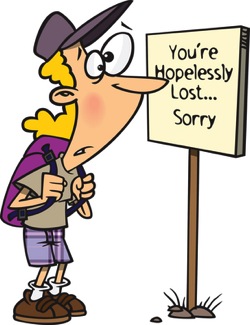
C536710 mThe Grasshopper usually delivers “How to” vs. “How not to” messages, but over the weekend he departed from the practice and said this: “You know you’re not going to make it if you’re waiting for your ship to come in and you’re not even at the dock.”

Translation: You’re lost!

We all get lost in something and some of those things have a deleterious effect on our future. The obvious ones come to mind – drugs and alcohol. I haven’t met too many substance abusers who weren’t waiting for something to happen without participating in the process to make it happen.

When you’re lost, you have lost your vision of what’s possible and you hope against hope that someone will come find you and save you. Here’s a mega dose of reality: No one’s looking for you.

That doesn’t mean people aren’t willing to help. They just need a little sign that you’re willing to help yourself.

It’s easy to spot someone who is lost. They have “no purpose” written all over them. They have a list of pie-in-the-sky dreams but never take their feet out of the clouds and walk the path on earth that will take them to their goal.

They tend towards gluttonous behavior and it’s always the next new thing that’s going to propel them to their dream, only to quickly lose interest when another new shiny thing comes along. They have a lot of starts and rarely finish.

For anyone familiar with the Enneagram personality typing system, the above description would be the downside of an Enneagram 7.

So how do we get found? The process begins by finding out who we are past the labels we accepted about ourselves. Behavior gets labeled; your core essence has no label that sticks, but when you find it, a purpose starts to form and your stick-to-itiveness kicks in.

Finding yourself is an inside experience and not another outside adventure. Inside there are not multiple things clamoring for your attention, just a still pond to reflect on.

It’s hard to convince someone who is lost that it’s not out there because that’s their conditioned belief. Your mission, should you accept it, is not to judge them, but rather point out, unemotionally, how their current belief isn’t working for them. Then point them in a direction that shows them how to go inside and quiet their mind, so they can leave lost and the limiting labels behind.

All the best,

John


Be Sociable, Share!


August 26, 2013

Environment

Filed under: John Morgan's Blog — John Morgan @ 5:37 am

C409133 m“Create an environment” goes hand-in-hand with “Build a Life” in the “words to live by” department.

Living a life and building a life are two different things. If you are just living a life, you are a passenger, rather than a driver.

Building a life needs the enlistment and cooperation of others and that’s where creating an environment comes in. If you want to entice others into the life that you’re building, you have to create an environment – one that makes them feel good about being part of this project.

Whether it’s asking another for their hand in marriage or asking someone to buy your widgets, you need to create an environment where it’s easy for them to say “Yes.”

How do you go about creating an environment? Yes, it helps to have a plan but that’s often not attractive enough. Getting them to the point that they can entertain saying “Yes” requires an environment that’s comfortable for them. How do you make someone feel comfortable? Give them your attention. Make your main focus tending to them rather than what you want them to buy into.

When you create an environment by sending your attention out, people will more easily be attracted to you and, by extension, whatever it is you are building or selling.

How do you give attention? Cease planning what you are going to say when another is speaking. The old railroad sign comes to mind – “Stop, Look & Listen.” Stop talking to yourself in your head when another is speaking, give them the benefit of your gaze and hear what they are actually saying.

Create that environment with the people you meet and you will have a crew at the ready when it comes to building a life.

All the best,

John


Be Sociable, Share!


August 23, 2013

Conditioning

Filed under: John Morgan's Blog — John Morgan @ 6:52 am

C442778 mCall me late to the party on the following distinction but it just dawned on me that there is a difference between being out of shape and being out of condition.

In regards to your body, being out of shape indicates that your shape has changed shape – meaning you have packed on pounds, not muscle. If you are out of condition, your appearance may be quite acceptable to you and others, but even though you look good, you can’t keep up with those who are highly conditioned. That means, to cite a sports reference, they are in “game shape.”

Is your conditioning in game shape? Chances are, if you’re anything like me, you are out of condition.

Most of the world is focused on shape – outer appearance; Changing your life has nothing to do with your shape and all to do with your conditioning. Focusing on shape can have you look the part but you can’t play the part.

Do you hate it when you run into a self made rich person who’s dumber than a doorknob? “How did that idiot manage to make all that money?” He/She ignored their appearance and got conditioned in the ways of making dough.

Shape and smarts are good for bragging rights but results depend on proper conditioning.

Is your lack of proper conditioning standing in your way? You bet.

What is proper conditioning? It’s recognizing that your conditioning is out of shape. That means to take notice that what you repeatedly are doing isn’t working. We seem to think that if we run at a closed door and bounce off, that all we have to do is hit it harder the next time. That will get you black and blue but won’t get you the blue ribbon.

Don’t escape to your dreams and aspirations as a remedy; look at your actions. We may be a thoroughbred in our thinking but a horse’s ass when it comes to our actions. That type of conditioning keeps us out of the winner’s circle.

If you aren’t getting results, you are out of condition. That means you have to adjust your actions, not your thinking. Adjusted actions lead to proper conditioning; Thinking about actions keeps you inactive, unable to compete.

Are you BS-ing yourself? Yes, if you talk a good game but don’t have the conditioning to back it up.

Want to shape up? Notice that your conditioning isn’t working and recondition yourself by taking action in a new direction. It’s how losers become winners and fantasies become reality.

All the best,

John


Be Sociable, Share!


August 21, 2013

Perspective

Filed under: John Morgan's Blog — John Morgan @ 7:30 am

C133559 mIs it better to be inside looking out or, as the old love song goes, on the outside looking in? It depends.

It seems to me that what we’re looking in on is the past; what we’re looking out on is the future. Both views have their up and down sides.

Wanting what you had, when it’s no longer available, is the downside of looking in. The upside of looking in is discovering and adjusting patterns of behavior that got you on the outside in the first place.

Looking out on a brighter future is the hope that keeps you going. That’s the upside of looking out. The downside of looking out is that we spend so much time doing it rather than doing something to make it happen.

Looking back and looking forward are perspectives. Right now is where your past and future meet. It’s not a perspective; it’s a reality. The downside of reality is that you ignore it and, by doing so, will always pay a price. The upside of reality is discovering that, no matter what the situation, you have the ability to respond to it.

Responding is not reacting. Reacting is doing what you did in the past. Responding is not escaping the moment and wishing for a different future. That’s just another conditioned reaction. Responding is the gift life has given us to interact with the present.

What reality are you attempting to put perspective on? That has the same success rate of trying to put lipstick on a moose. Looking back on a better time or looking forward to a time that will be better are reactions that keep you from responding to what’s right here, right now.

Reminds me of a story . . . Years ago, I was in Kentucky to do a seminar. The hotel where we were holding it had one meeting room which we were assigned. The trouble was that it was filled with tables, chairs, and dirty plates from a wedding reception that was held in there days before. The person at the front desk, the only staff person in the hotel, told me that the cleaning and setup of the meeting room was not staffed by the hotel but by an outside company and they didn’t work on Monday. I had a reality on my hands.

I told him that we had a meeting in there in about 4 hours and that it needed to be cleaned and set up as per our agreement. He said our agreement was not with the hotel but with the catering company and he repeated they didn’t work on Monday. I was frustrated and about to get into a long, heated debate with this fellow until I recognized that I was reacting. I was reacting to the way it should be rather then to the way that it was.

I looked directly at him and said, “You are the only person that can make this happen. I don’t know who to call to make this happen but you do. Make that call now and make this happen.”

A half hour later two people were on site to clean and set up the room. I could have eloquently argued for hours about how things should be or how they were in the past but that would not have gotten me a functional meeting room.

Putting perspective on reality is ignoring reality. Responding to what’s right in front of you is always an action plan, not a reaction plan.

Gaining perspective may make you smarter but when it comes to reality, it’s a non-starter.

All the best,

John


Be Sociable, Share!


« Previous PageNext Page »