 The Grasshopper offered up something yesterday that made me smile: “If you’re not laughing everyday, something’s wrong.”
I don’t think his message suggests becoming a “grinning idiot”; it’s more of a nudge to start noticing the lighter side which is available even on cloudy days.
“Laughter is the best medicine” is an interpretation of Proverbs 17:22 which reads: “A joyful heart is good medicine, but a broken spirit drys up the bones.”
I don’t think I’m revealing any secrets here by saying that miserable people are dried up and their brittleness infuses everything they do.
Misery and looking for the lighter side are both mindsets. One takes you down a dark road; the other offers brighter options.
Norman Cousins was a journalist and author of the book Anatomy of an Illness. After suffering a life-threatening disease, he discovered alleviation through laughter. Quoting Cousins, “I made the joyous discovery that ten minutes of genuine belly laughter had an anesthetic effect and would give me at least two hours of pain-free sleep.”
It’s in your best interest to regularly find something to laugh about. The soothing result is this: Finding time for mirth makes your existence less painful on earth.
Final thought: If you choose to remain steeped in misery, it’s nothing to laugh about because the joke’s on you.
All the best,
John
Be Sociable, Share!
Comments Off on Belly Laughter
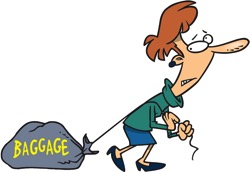 Came across this past nugget from The Grasshopper:
“Our Personal Baggage: We’re Over-Packed For The Trip Of Life.”
Over the years I have been fond of labeling someone I couldn’t cozy up to as having too much baggage. That meant they had too many obstacles in the way of me getting closer to them.
The real discovery was it was my own baggage that got in the way of me getting to know someone better.
Let me re-label baggage as our “prejudice, patterns or conditioning.” We accumulate a lot of conditioning along the way and it weighs us down when it comes to warming up to others.
The key to better relating is to discover we’re not better than another – just someone who’s been conditioned differently. When we trace the conditioning path we have traveled, we can see the stops where we picked up a specific piece of luggage.
Oftentimes, we picked up the baggage by osmosis, meaning we learned the new patterns, prejudice or conditioning without knowing we learned it. It just seems to be something we were born with. Tracing our path shows us it was not.
Examining our conditioning, dispassionately, shines a light on our own baggage, allowing inspection to be much easier. What you’ll discover is that you are carrying too much. The key, going forward, is to pack lighter, by leaving the extraneous behind.
This results is you being lighter (translation: less serious) and not taking yourself so seriously. This lightness will open you up to more people, resulting in more ease in relating because there is less baggage to bog you down.
Packing light allows us to see more of the light and exposes our dark side, so we can leave it by the wayside.
All the best,
John
Be Sociable, Share!
Comments Off on Bag Your Baggage
 I’m guessing you’re familiar with the old time, pejorative phrase “You’ve been sold a bill of goods.”
Let me state the obvious: You can’t be sold a bill of goods if you’re not buying.
This is not a warning to stay home and “sew up your pockets” as much as it is an invitation to notice what you’ve been sold that’s proving to be worthless.
We’ve been sold on too many third-rate things to count through our conditioning. The key is to find one of them and start pulling on its string. This realization and action begins a domino effect on our other bills that aren’t that good.
What have you been sold, without your permission, that’s holding you back from viewing reality?
Is it a way of life? Attitudes? Prejudices? Zero in on what you’ve been sold that can’t be resold. Come around to the idea that it’s a worthless commodity that has strung you along and has led you deeper in debt.
Animal lovers beware: You may have to slay a few, sacred cows to get to the point where you are debt free from these bills.
It’s a process – one that begins with reflection on the hole you’re in. As the Grasshopper warned years ago: “Change your behavior or stay in your hole.”
What are you passionately defending that doesn’t hold water? By mindlessly defending, you are using a sieve for a bucket.
Take a moment to focus on the results you consistently get. If they are unfulfilling, become willing to inspect your behavior. What you’re likely to find is an old bill not worth paying.
All the best,
John
Be Sociable, Share!
Comments Off on Bill of Goods
 Here’s an old Grasshopper Note that has real potential.
“Potential Is An Empty Promise.”
The seed needs the soil otherwise you only possess the downside of potential.
Are you as smart as someone who’s way more successful than you? The answer to that question is almost always “Yes.” Are you as resourceful as them is a much better question to ask yourself. The answer to that question is almost always “No.”
What resources are they using that you’re ignoring?
Internal resources immediately come to mind. We block most of our internal resources by our incessant thinking. When you are thinking, your chances of reaching the rich soil of your creative resources are thwarted.
The key to getting your seeds into this soil is to get out of the barren fields of your mind and into the fertile environment where your potential can grow, not just be lamented about.
How much of your thinking is about how successful you should be vs. the reality of how successful you are? I’m defining “Successful” as measurably accomplished.
Measuring your thinking is just comparing IQs, which are accidents of birth. Measuring your accomplishments is a more useful barometer of how often you get your ideas and hands in the dirt – the key to success.
If you want your potential to grow, you have to get past knowing what you know.
That means to get out of your head and into the infinite field of resources where the act of planting is measurably ahead of anything that’s said.
All the best,
John
Be Sociable, Share!
Comments Off on Potential
 Using baseball as an analogy, a spectator is a fan watching or listening to the action on the field. A participant is the player on the field.
In your field of dreams are you a spectator or participant?
My experience is most of us fall into the spectator catagory.
That means we watch life go by and rarely jump in to participate.
For example, we live vicariously through others watching something like the Kardashians on TV. We may dream of another lifestyle or another direction to head in but never take the first participating step.
You can learn how to do something from a book or a YouTube video but if you don’t execute the steps, you remain a spectator.
It’s nice to be a compendium of information on a topic but it’s beyond words when you actually participate.
Quoting the Grasshopper from many moons ago, “Plans without follow-through are dreams that die.”
Want to start living the dream? Participate!
All the best,
John
Be Sociable, Share!
Comments Off on Spectator or Participant
 Lots of people are preparing to die. They make sure their insurance and will are in order, burial plot or cremation secured, organ donation detailed, and list the type of funeral gathering they desire. That is quite prudent and my guess is these folks make up a small percentage of the population.
Even less people are preparing to live.
If you don’t feel alive everyday, you are at death’s doorstep.
Feeling alive is recognizing the moment you are in and making the most of it. It won’t be coming around again, so take advantage of it while its here.
Seems we often withdraw from the moment we’re in to be somewhere else. That somewhere else is being in our head – a giant moment killer.
Participating in moments makes us feel alive and well. All else disappears when we engage in the moment. If you are having a conversation with someone and you go inside your head to rehearse what you are going to say, you’ve come out of that moment and, more importantly, lose the aliveness of connection with the other person.
I have no idea how long I’ll live. That decision is out of my hands. Deciding to live everyday of your life is a choice you can make. It starts with participating in life’s moments.
Big and small moments are labels that indicate a head trip. All moments, no matter how they are judged afterward, deliver equal amounts of life.
Prove it to yourself. Participate in more moments and measure you aliveness. What you’ll discover is that staying in your head keeps you in the dead zone. Coming out to play will make you feel alive everyday.
All the best,
John
Be Sociable, Share!
Comments Off on Prepare to Live
 Is it “Wayback Wednesday” already? Must be because below is a Grasshopper note from long ago:
“A More Active Life Leads To More Happy Accidents.”
I’ve always liked the word “serendipity” but never knew its origin. It comes from the fairy tale The Three Princes of Serendip where the three princes were making accidental discoveries while they were in search of something else.
Seems that we all have made accidental discoveries when in search of something unrelated. Serendipity is alive and well in our lives and we would do well to set the stage for it to appear more often.
The trick is not to go looking for serendipity but to commit to doing something vs. thinking about something. Doing gets you out and about; thinking keeps you shuttered and stout. Taking action gives serendipity the opportunity to find you.
The arithmetic works like this: The more you get out and do, the more often you have a chance of serendipity visiting you. It’s most often the byproduct of activity and interaction. Action will lead you to people and places that thinking can never take you.
Have you ever had a chance meeting that turned into something larger than you could have ever imagined? It happens to someone every day when they get their isolationist thinking out of the way.
Here’s the big secret: Serendipity will not come knocking on your door. You’re more likely to bump into it if you put yourself where it lives – outside of your head.
Serendipity is in direct proportion to you putting yourself out there. And when you do, please don’t act too surprised when it taps you on the shoulder and asks you to dance.
All the best,
John
Be Sociable, Share!
Comments Off on Hooray! For Happy Accidents
 Came across an old Grasshopper Note that is as close as I can get to defining “True.”
“True: What You Do.”
I’ve had a hard time with the word “truth” for a long time. Based on my experience, “truth” had too many interpretations, like “my truth,” “your truth” and that old standby “it’s the truth.”
I am now comfortable with a definition of what is true: It’s what you do.
How often have you said something as stupid as this: “I know what I’d do in that situation.” No you don’t. You know what you think you would do and you label that as true. Too often we don’t do what we think we would do, so our pronouncement often isn’t true.
True is only what you do do, and I don’t mean that in a smelly sense.
Your words are sometimes true; your actions are always true, because true is what you do.
“I went to the store” is true. “You went to the store with the intention of robbing it,” says the prosecutor. That may or may not be true.
True can be verified by cataloging your actions, not by interpreting them.
I’ve grown weary of the word “true” as it’s commonly tossed about. There are too many false premises in most peoples’ use of the word.
“True” doesn’t have modifiers. “It’s a.m. here on the east coast.” That’s true if it’s after midnight and before Noon. “It’s a lovely morning here on the east coast” is debatable.
Leave the modifiers out of your actions and you’ll be telling the truth.
My main purpose in writing this is to call attention to our often, lame attempts to justify our actions. It’s really this simple: You did what you did and that’s the truth.
All the best,
John
Be Sociable, Share!
Comments Off on Is Your “True” Dog Do?
I had an interesting thought pop in the other day: “I was stupid until I wasn’t.”
To me that meant I was locked in to stupid before I wasn’t. There was a learning experience waiting on the other side of stupid, I just didn’t notice it, until I did.
That prompted this fill-in-the-blank: I was ________ until I wasn’t.
What are you locked into? There is a key to your lock. But it takes some reflection to find it.
The operative word in the fill-in-the-blank statement is “was.”
Notice that “was” indicates it’s in the past. The reflective exercise is this: Refer to what you were locked into as being “in the past.”
“In the past” is a concept I learned from Dr. Dave Dobson. Below is an excerpt from a free ebook I offer on success that illustrates Dave’s teaching:
“In the past” is a phrase that works its own magic when continuously applied. If it is your habit to say, “I’m not very artistic,” say something like this instead. “In the past, I haven’t been very artistic.” The consistent referencing of the observation as “In the past,” is a pattern interrupt. The pattern interrupt, “In the past,” sets the stage for your mind to come up with additional options that will move you forward.”
There is magic in the phrase “in the past.” You just have to practice the trick often enough so you have it down pat.
“In the past” is the key to the lock. Practice using the phrase until you open up unseen options – options that free you from the limiting concept that seemed like a life sentence.
I was unaware of this technique until I wasn’t.
Now it’s your turn to turn “is” into “was.” It’s a simple matter of practicing the English rules for tense that you learned a long time ago.
Is “in the past” the key to your lock? Jiggle it a few times and find out, first hand, what’s on the other side of “was.”
All the best,
John
Be Sociable, Share!
Comments Off on Locked In
 Have you ever described someone as “Different”? In most cases it’s a put down. “Let’s be kind and say he/she’s ‘different.'”
What does different mean? I’m sure there are many interpretations but here’s mine: Different = Not like me.
This opinion comes from an attitude of superiority. “Not like me” means I’m better. Not necessarily better in the sense of measurable data but better in our world view.
We assessed that our vantage point is the best without investigating the angles of view others have. That’s a limited view that cries out for expansion.
What makes someone different? Adopt their angle of view and you’ll have a better sense of how and why they do the things they do.
We’ve all been asked the hypothetical question: “What would you have done in that situation?” We immediately come up with an answer different from the one that was apparently used by someone in that described set of circumstances. The real answer to that question is, “I don’t know.”
We may think we know what we would do, but if that same scenario presented itself to us, we may act in the same way the other person did.
“Walk a mile in my shoes“ is more than an old expression and an old song title. It’s an invitation to find out that different is the same depending on the circumstances.
Reminds me of a story . . . Years ago, I had a disagreement with another person at a seminar we were both attending. We said some nasty things to each other. Fast forward to a few hours later when cooler heads prevailed and we declared a truce and decided to just talk. The disagreement was about how we differed in our treatment of people. I thought my position was right and she thought hers was the correct position. it all came down to different conditioning. Then I remember this popping out of my mouth: “Ya know, if I was brought up in your house, I would probably have the same view as you and the reverse is also true.”
We weren’t really that different; we just had different conditioning.
My experience is this: If you view someone from a different angle, you may begin to notice that they’re not so different.
All the best,
John
Be Sociable, Share!
Comments Off on Different


