
GrasshopperNotes.com - Thoughts for inspired living


July 23, 2020

Which is Better?

Filed under: John Morgan's Blog — John Morgan @ 11:20 pm

PC vs MACAs I’ve written before, “Better” and “Best” can be fighting words, especially when used with people who like to mix it up.

When someone asks your opinion, better and best don’t seems so offensive as to put someone on the defensive.

It’s when you offer an unsolicited, emphatic assertion that contains those words that you should get ready to duck. It’s highly likely that you’ll get into a verbal dust up, especially if the person you’re directing it to has a much different view.

When offering a better or best opinion, it’s “best” to say something like this: “I find that this one works better for me” OR “The one I like best is this one.” When you choose to use this type of phrasing while using “I” and “Me,” you are stating preferences, not citing bible verses.

“The best football player ever is Tom Brady.” Can you see how that statement will get someone’s fur to fly, especially if they’re not a Tom Brady fan?

This is a gentle reminder that a subtle shift in language that takes you from absolute assertions to personal preferences will keep things in conversational mode instead of going down a rocky road.

Which way is better? The way that works best!

All the best,

John

Listen to the recorded version.


Be Sociable, Share!


July 22, 2020

The Universal Affliction

Filed under: John Morgan's Blog — John Morgan @ 6:40 am

Adrian swancar 72El6N0cmj4 unsplashThere’s another global pandemic going on besides the one that’s monopolizing the news. It’s been active since the time of Adam and Eve and, best as I can tell, no time soon is it going to leave. It’s the universal affliction of being stuck in our head.
If we charged out thoughts by the hour for taking up space in our mind, Jeff Bezoz and Bill Gates would be considered paupers by comparison.

When we’re in our head, which is most of the time, we are absent from our life. We’re in a pseudo-world that has nothing to do with what reality is presenting to us 24/7. We’re living on a movie set when we’re in our head. We are all storefront and no store. Our aliveness disappears and is replaced by what Bob Dylan called, “jugglers and clowns.”

Did you ever notice that when you stop thinking, you become an active participant in life? You’re more in touch with your senses and your aliveness can be seen, heard, and, most importantly, felt.

Excessive thinking is insidious. It sneaks up on you and before you know it, you’re overpowered by it. What to do?

The starting point for getting out of your head is to notice that you’re in it.

Noticing is the cure.

When you begin to notice your thoughts from a distance as an unemotional observer, you return to your body where life is actually happening. Getting out of your head and into your body can be easily done. Here’s one way that works:

When you notice that you’re in your head, acknowledge it by saying to yourself or aloud, “I’m in my head.” It’s a pattern interrupt that will interrupt your thought process long enough to activate your senses. Then, if the situation permits, close your eyes and do an inventory of your body. That means to bring each body part to mind (feet, hands, legs, stomach, neck, etc.) and just notice (feel) what’s going on in that part of your body. The whole process can be done in under two minutes.

When you activate your senses, you are no longer a member of the walking dead who’s trapped in their head. You are you – alive and present.

Truth be told, we’re probably never going to completely stop thinking, but we can mitigate it long enough to experience what alive feels like. The more often we notice our thinking, the less often we’re bound by it, and the more vibrant our life becomes.

Make it your mission to experience more of life today. You do so by letting your body have its say.

All the best,

John

Listen to the recorded version.


Be Sociable, Share!


July 21, 2020

Follow-through Bugaboo

Filed under: John Morgan's Blog — John Morgan @ 5:16 am

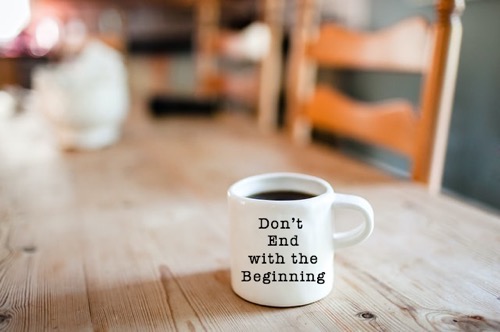
Don t EndThe Grasshopper had this to say this morning, “The biggest bugaboo is follow-through.”

It didn’t take me too long to realize he was referring to us starting but not completing.

Some folks are perpetual starters. They get a creative notion but it doesn’t take form due to a lack of motion.

In order to get through to the other side, it’s helpful to follow this practice: Master the foothills before you attempt to scale the mountain.

We’ve become a shortcut society. Everything is wanted by yesterday. The seeking of shortcuts becomes our shortfall because we use so much of our time looking for ways to avoid the work that’s necessary for completion to take place.

I remember my friend Paul interviewing the author of the famous “Spenser” books, Robert B. Parker. When asked about the daunting task of writing books (a mountain if there ever was one), he said something like this: “I set aside two hours each morning to write. Some mornings I write a sentence or two in that time frame. Other days, I can’t stop writing and go past the scheduled time.” The point being that he set the time for work and adhered to that practice.

So, to put a finishing touch on The Grasshopper’s musing, you’re guaranteed to be more productive if you follow Robert B. Parker’s example. To use a manufacturing term, It will keep your “throughput” from going kaput.

All the best,

John

Listen to the recorded version.


Be Sociable, Share!


July 19, 2020

Subtracting From Your Substance – Recorded Version

Filed under: John Morgan's Blog — John Morgan @ 8:50 am

Here is the recorded version of the Grasshopper Note for the week of 7-20-20.

Read the written version here.


Be Sociable, Share!


July 17, 2020

Misapplying The Facts

Filed under: John Morgan's Blog — John Morgan @ 6:52 am

Laura kapfer hmCMUZKLxa4 unsplashOur world has highly educated and highly experienced people. Often these two peoples’ are at odds.

Highly educated, smart people aren’t necessarily experienced. And experienced people aren’t necessarily smart.

In America, we build altars to one and keep the other on the church steps. Can you guess which one is exalted?

Common sense is available to both, but it seems one uses it more than the other. Can you guess which one?

Smart people are great arguers. Experienced people let their results speak for themselves.

Smart people cite facts to make their arguments. Experienced people don’t let facts deter them. It’s not that they don’t recognize facts; they just don’t misapply them.

Perhaps a story would be helpful . . . Here’s my experience when attempting to help very smart people overcome something that’s getting in their way. Smart people are harder to help because they amass abundant facts and build a wall around themselves with them. It’s hard to penetrate that wall and get them to see that they use facts as a defense of their limitation.

Smart people often confuse themselves with the facts. They find a never-ending list of them to declare and defend their position that something’s not possible, whereas the experienced person is more focused on the outcome they want and don’t let the facts get in the way.

It seems the smarter we are, the more abundant our facts, and our excuses.

This is not a rant against smart people. I love them. They bring unlimited perspectives to things I would never have thought of. It’s more of an acknowledgement of experienced peoples’ accomplishments – ones they were never schooled in.

Here’s my self-educated request: Show me your experience, not your argument.

All the best,

John

Listen to the recorded version.


Be Sociable, Share!


July 15, 2020

The Creative 2-Step

Filed under: John Morgan's Blog — John Morgan @ 6:31 am

Isaiah mcclean 9 D4NtyYHE8 unsplashWe do a lot of dances in a lifetime, probably the most famous being, “Two steps forward, one step back.” That one’s like “The Twist”; everybody can do it.

There is another dance that requires two steps. We often do the first one but don’t do the second to complete the move. I call it “The Creative-2 Step.”

And coming from someone who is a “Johnny Castle Dance School” dropout – me, I can attest that “The Creative 2-Step” is easy to learn, but it takes follow-through. You have to do Step number 2.

If you don’t, you only do half a dance. It would be like doing “The Cha” instead of the “Cha-Cha.”

So, here are the two steps to the Creativity Dance:

1. The Inspiration.

2. The Implementation.

How often have you gotten a creative idea from out of the blue and then just let it sit on the shelf and collect dust? Or maybe you got the inspiration but you put it in the attic or basement of your mind where it still sits unfulfilled.

To be truly creative requires both steps. The American poet and diplomat James Russell Lowell said it this way: “Creativity is not the finding of a thing, but the making something out of it after it is found.”

And Julia Cameron famous author of “The Artist’s Way,” had this to say, “Creativity is God’s gift to us. Using our creativity is our gift back to God.”

There is a part of us that knows how to do the Creativity Dance. In order to let that ability to come through, we have to practice doing step number two.

All the best,

John

Listen to the recorded version.


Be Sociable, Share!


July 13, 2020

The Calming Sea

Filed under: John Morgan's Blog — John Morgan @ 6:22 am

Andreas dress y7x29op39XU unsplashDo you find looking at the ocean calming? How about gazing over a still lake; does that quiet and calm you? Most folks answer “yes.”

I got to wondering what it is about these sights that take us out of our head and into our senses. Here’s an answer I came up with: The scenes are vast and there is nothing else in them to distract us. Our focus is on one thing – the only thing in our view. That’s hypnotic.

Think of the movie scene where a hypnotist swings a pocket watch on a chain and asks the subject to follow its movements. The person’s attention is on one thing, and one thing only, and they are easily lead into a calmer, undistracted state of mind.

Objects that we laser focus on are vehicles that transport us to what The Buddha called, “no mind.” Whether you repeatedly chant “OM” or devoutly recite a prayer, it acts as a vehicle to take you from here to “there.” “There” being a place where you’re not distracted by your thoughts.

Many have a name for this place: Nirvana, Utopia, The Kingdom of Heaven, etc. The descriptor I use is the “Cauldron of Creativity.”

A quiet mind is a creative mind. No distractions telling you what’s not possible.

Just in case you think this message is for the “touchy-feely” crowd, consider the words of the highly successful entrepreneur and investor Naval RaviKant:

“A busy calendar and a busy mind will destroy your ability to do great things in this world. If you want to be able to do great things, whether you’re a musician, or whether you’re an entrepreneur, or whether you’re an investor, you need free time and you need a free mind.”

Want more smooth sailing? Focus on calming seas.

All the best,

John

Listen to the recorded version.


Be Sociable, Share!


July 12, 2020

What You Have, Not What You Had – Recorded Version

Filed under: John Morgan's Blog — John Morgan @ 2:40 pm

Here is the recorded version of the Grasshopper Note for the week of 7-13-20.

Read the written here.


Be Sociable, Share!


July 10, 2020

Subconsciously Steeped in Story

Filed under: John Morgan's Blog — John Morgan @ 5:45 am

Nong vang 9pw4TKvT3po unsplashI will forever be awed by the power of a story. Stories are like electricity: They can either illuminate or keep us in the dark.

Some powerful stories are legendary and, in many cases, transformative. They appear in sacred texts, works of art, memorable films, etc.

Other powerful stories are constricting and constraining. These are mostly our personal stories. The sad part about these accounts is that we don’t know the governor they have on our ability to move forward.

We can be very vocal about our stories and tell them to anyone willing to listen. But even if we’re secretive and only tell the story to ourselves, we reveal its existence to others with subconscious, subtle clues that slip out.

I will be forever grateful to author and spiritual teacher Byron Katie for the profound question she asks: “Who are you without your story?”

Our stories often serve as justifications for why we are the way we are. We are subconsciously steeped in these justifications and what we reveal to anyone willing to pay attention is that we’re not willing to give up these rationales for our behavior, and thus we live “Groundhog Day” over and over.

I often cite this absurd story to make the point: “I’m the child of verbally abusive, emotionally unavailable, rodeo clowns.” Yes, the facts of your story are not in dispute. They are building blocks for why you are the way you are.

Now, the question is: Do you want to outgrow who you were conditioned to be or stay stuck there the rest of your life? If it’s the former, STOP TELLING YOUR STORY.

If you want to stay handcuffed to your past, continue justifying why you are the way you are.

If you’re looking to move on and attract new vistas, say, “hasta la vista” to your story. Yes, it’s an accurate, historical reference and needs to be told if you choose to share your personal history with someone. But if you use it as a justification as to why you are the way you are, your history will continue to repeat itself.

Legendary, Swiss psychiatrist Carl Jung gave us the prescription for outgrowing our past: Make the unconscious, conscious. What he specifically said was, “Until you make the unconscious conscious, it will direct your life and you will call it fate.”

Do you really want your life to change? Then, change your story.

All the best,

John

Listen to the recorded version.


Be Sociable, Share!


July 9, 2020

All Relationships End

Filed under: John Morgan's Blog — John Morgan @ 4:53 am

Clay banks joP6x Dj6mM unsplashI don’t think I’m revealing any top secret information by saying that all relationships end – some naturally, some amicably, most of them sadly.

Parting of the ways happens in too many ways to count, yet they happen every day. Someone, once near and dear to us, is either no longer on this earth or is no longer in our life.

The message here isn’t intended to engender doom and gloom or to focus on regret; it’s more of a wake up call to get us to pay attention – to the relationships we currently have.

I believe we take too many of our relationships for granted, and don’t offer them the attention they need to stay alive while we’re all still living.

I think of the Harry Chapin song “Cats in the Cradle” – the essence of which has him too busy to pay attention to his son. Life got in the way of him spending the time, and then the relationship just slipped away.

Our relationships need the investment of our time and attention. If we have them in “set and forget” mode, it won’t be too long before they’ll forget about us.

Is there someone in your life right now that needs more of your attention? Lean in and let them know, otherwise you may have to watch them go – away!

Make it your mission to let someone special know that they’re special, today.

All the best,

John

Listen to the recorded version.


Be Sociable, Share!


« Previous PageNext Page »