
GrasshopperNotes.com - Thoughts for inspired living


January 13, 2015

Formula for Fresh

Filed under: John Morgan's Blog — John Morgan @ 7:42 am

C513775 mHave things gotten stale? The following is a formula for freshening up. Note: It’s nice to know about the formula but it only works if we use it.

We are either reacting or responding to the ever-present stimulus known as Reality. Think of reality as a carrot that’s always dangling in front of us. Each day our life is filled with unforeseen and abundant realities, and how we answer them determines the freshness of our life. We can have a very predictable, repeatable existence or we can create our lives each moment. The path we wind up on is directly caused by a reaction or a response.

Reactions have us “re-acting” the same way again. We act like the actor who can only play one role. No creativity comes from a reaction, only predictability. We have been conditioned to give the same reaction to the same stimulus and haven’t noticed how stale we’ve become.

A reaction is a remedy we’ve used before – a remedy that may not be working now. We get so caught up in our reaction (the way it’s supposed to be) that we don’t notice we’re not being rewarded anymore.

If your life has you taken down the “dead-end stale trail,” you are a victim of your reactions. You have defaulted to one way of reacting. It seems like the only way, even though you know it’s tired and worn out. You need a creative intervention.

Creativity (Freshness) is the result of a RESPONSE.

There is magic in a response because it allows you to cross the border into creativity and find solutions reactions never look for.

Reminds me of a story I’ve told before . . .

About 30 years ago I was conducting a seminar for a computer company in Augusta, Maine. I was discussing the difference between a reaction and a response. I asked a young strapping lad of 28 what he would do if someone called him a derogatory name. He said, “I’d whack them.” I then asked him if he knew who Billy Martin was. He said, “He’s the former manager of the New York Yankees.” I asked if he knew how old Billy was. He said, “Late 50′s.” I further probed if he knew anything else about Billy. He said, “Yea, he gets in fights in bars.” I then asked him if he would be getting in fights in bars when he was 58. He said, “no way.” I then asked, “What magical metamorphosis is going to happen between now and then to keep you from whacking people who call you names?” I then added, “What if when someone calls you a name, you pause and then say, “if you knew me a little better, you may like me more’.” He smiled and he got it.

There is a stimulus (Reality) and there is a conditioned reaction (what you normally do). When you take time to choose a response, you are making life easier and more fresh. You acknowledge reality but you choose not to fight with it because you will always lose.

Before I knew about responding to reality, I felt locked in to some predestined plan that just didn’t feel right for me. I found that most people are under that locked-in delusion and response is the universal remedy – a passport to a life of fresh creativity.

Remembering to use the formula will be your biggest challenge because our reactions are so familiar to us. Noticing your reactions and interrupting them while they are happening, and coming up with a response instead, puts you at the doorstep of fresh.

A fresh response will have “humdrum” leave town with “stale” on its tail.

All the best,

John


Be Sociable, Share!


January 12, 2015

Owning Up

Filed under: John Morgan's Blog — John Morgan @ 8:21 am

0Who doesn’t have problems? Dead people, of course.

That’s a reality that’s easily admittable; here’s something that’s not: our part in the problem.

The Grasshopper came out of his New Year’s slumber and offered this: “If you don’t own the problem, you’ll find it difficult to find a solution.”

Owning the problem is acknowledging our part in it. I’m reminded of an episode of the 70s TV show Happy Days when character, Arthur Fonzarelli (The Fonz) had trouble admitting he was wrong. He knew he was culpable in the situation but had trouble getting the words “I’m wrong” to form in his mouth.

That’s the biggest hurdle in problem solving – admitting that we may be part of the problem. That’s because no one wants to be wrong. This hesitancy to own up is a delaying tactic that keeps a solution down.

When the focus continues to claim responsibility is “out there,” the solution remains out there as well.

Yes, there are some unfortunate things that happened that we had nothing to do with – let’s call them “acts of god.” But we claim “godliness” far too often when we’re part of the devil in the details.

Owning a problem facilitates a faster solution. When we don’t look in our direction too, we ignore an angle of approach that could hold the key to our solution.

“Own up” is easy to say and hard to do due to our cultural conditioning that being wrong is a deadly disease. It’s not. It’s a shortcut to a solution.

If you’re hellbent on keeping your problems in place, just continue to pretend that you had nothing to do with them. Then if you want to keep them in place even longer, go find some people who agree with you and you can talk forever about the bastards out there rather than looking “in here” for a solution.

We are part of the problem. The sooner we recognize that, the sooner we can put all our energy into finding a solution.

I’ll end with a quote from author Susan DelGatto: “If you choose to not deal with an issue, then you give up your right of control over the issue and it will select the path of least resistance.”

All the best,

John


Be Sociable, Share!


January 7, 2015

This means . . .

Filed under: John Morgan's Blog — John Morgan @ 6:29 am

C786998 mDid you ever notice when you get an emotional feeling, you attach meaning to it?

We all get emotional over something and then we ascribe a reason to the feeling. The shorthand we use in these situations is: “This means that.”

My experience is when we equate an emotional this with that, we go on a downward spiral towards drama. Our transport vehicle is the “woe is me” wagon.

The next time you get emotional (yes, there will be a next time), stop and notice the sensations in your body that go along with the emotion. The sensations will register somewhere, usually along the front half of your body from your head to your bowels. For example, we can all relate to a lump in our throat, a gurgling in our stomach, a flushed feeling in our face, etc.

The trick to avoid the ensuing drama is to notice the sensations that go along with the emotion. That puts your attention on the sensations rather than having it go into “this means that” mode.

“This” rarely ever means “that.” I’m reminded of one of my favorite observances I learned from Dr. Robert Anthony. He said, “You’re rarely upset for the reason you think.”

It’s the thinking about the sensations that has them catch fire and start to burn out of control. If you begin noticing the sensations without ascribing meaning, you prevent “this” from becoming “that” and you won’t cause a 4-alarm blaze.

Get in the habit of exploring the sensations that go along with an emotion. That means to actually feel them, not equate them. Feeling is an in-body experience; equating is a long head trip elsewhere.

The sensations want to be noticed. That’s why they acted up in the first place. They want you to pay attention to them, not judge them. By paying attention, we let them have their “say,” allowing them to more quickly go on their merry way.

Application of this strategy turns “I’m sad because” into just “I’m sad.” There is no meaning attached to “I’m sad,” just the opportunity to feel the sensations that go along with sad.

Once you begin to extrapolate meaning, you guarantee that you will be mean to yourself and insure that heartburn won’t be far behind.

Jump off the meaning wagon and you’ll stop the never ending “tit for tat” that goes along with “this means that.”

All the best,

John


Be Sociable, Share!


January 6, 2015

I’m Gonna

Filed under: John Morgan's Blog — John Morgan @ 6:58 am

C482960 mIf there are two bigger resolution killing words than “I’m gonna,” I haven’t heard them yet.
The boulevard of broken promises begins with “I’m gonna.”

Reflect for a moment on past failures that began with these two words.

“I’m gonna be a millionaire by the time I’m 40.”

“I’m gonna go to the gym 5 times a week.”

“I’m gonna lose 30 pounds by Christmas.”

Don’t tell yourself or anyone else what you’re “gonna” do; tell them what you’re doing.

“Doing” is active and in the present; “gonna” is future based and promised to no one.

Any list of resolutions are wishes until actions take place. Action can only take place in the moment you are in.

Just a subtle shift in language from “gonna” to “doing” gives you a much better chance of fulfilling your wish.

Side Note: If you’ve added a start date to your “I’m gonna,” it’s doubly insured to fail.

“I’m going to start my diet on Monday” is a red flag that predicts a lot of bull will follow. Here’s a clue: If it’s not important enough to start now, it’s not important.

Please don’t tell yourself or anyone else what you’re going to do. Demonstrate what you’re doing. It’s a much more accurate predictor of success.

I was gonna write this blog post on New Years day but I didn’t.

All the best,

John


Be Sociable, Share!


January 5, 2015

Whatever Gets You Through

Filed under: John Morgan's Blog — John Morgan @ 7:47 am

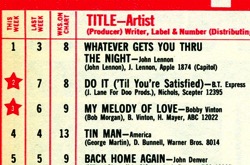
Bb39 coda charts john lennon 1974 billboard 650We’re all familiar with the phrase “Whatever gets you through the night.” It was even a popular song in the 70s. The problem with the phrase and the philosophy behind it is that it’s rarely a long-term solution.

The Grasshopper offered this: “Whatever gets you through the night won’t offer much light.” I took that to mean that “whatever” wasn’t going to shine a way forward.

Sometimes we all need a shoulder to cry on, but if that becomes our routine, we will routinely be pursuing whatever gets us through the night rather than seeking a way forward.

The way forward needs a brief look back as to how we arrived at our current situation. The purpose is to see the steps we took, so that we don’t misstep again. It’s one of the reasons why football players watch films of the games they played in – to gain perspective for going forward.

Once you know the path that leads towards the light, it’s time to let go of whatever gets you through the night. It may take a dark night of the soul or two to finally discover “whatever” isn’t working for you.

This is a simple but not necessarily easy process. The simple part is looking back to find out how you got here. Once you establish the pathway that got you to where you are, it’s time to stop taking side trips to “whatever” and put all your effort into blazing a new trail.

Whatever gets you through the night is a relapse against reality. It’s to make you feel good for the moment with no real chance of it being a stepping stone forward.

If you are constantly crying on shoulders, that should be your first clue that you don’t have a clue as to how to arrive at a solution. It’s difficult to get to a destination if you stop at every rest stop on the way. They become diversions from traveling the path that’s necessary.

What is necessary is to recognize whatever is going on with you is your problem. When we pretend our problems aren’t our problems, we put the onus out there somewhere. That sugarcoats it for awhile, but remember this: A sugarcoated turd is still a turd.

When the sugar wears off we find ourselves eating shit.

Sorry to be the “Dutch Uncle” here but no one is going to solve your problem but you. That’s the realization you need to bring yourself into the present where you can best fashion a future. You won’t get to the present, the only point from which you can change, until you put “whatever gets you through the night” in your rearview mirror.

All the best,

John


Be Sociable, Share!


December 22, 2014

Comparisons

Filed under: John Morgan's Blog — John Morgan @ 5:54 am

C635538 mIt’s my experience that external comparisons are just not that productive. By external comparisons, I mean comparing yourself to others. I find it much more useful to compare you to you – an internal comparison.

I was swimming laps yesterday and there was a man about my age in another lane being assisted by an instructor helping him complete his water aerobics routine. My routine is to swim 20 lengths of the pool and then take about a minute break before doing another 20 lengths. I then take another minute break and swim another 20 lengths. The swim totals about a mile.

During one of my breaks, the man commented to me that he was doing nothing compared to what I was doing. My response was that he was doing more than 80% of the population who were probably doing nothing. He laughed and then said, “I don’t think I’ll ever get to the level you’re at.”

I told him that I used to swim quite regularly years ago but had gotten out of the habit, until recently. I went on to say that 3 months ago, when I started up again, I could barely swim two lengths before being totally winded. I worked up to my current routine over time.

I vividly remember the first day back. I was beating myself up for not measuring up. I was watching other people swim and noticed they were doing a lot more than me and was fretting that I couldn’t do what they could. I was using an external comparison. That, for me, is not motivational.

What I found motivational is comparing what I did today to what I did yesterday. That’s a manageable, personal measuring stick. You’re not comparing yourself to the elite, only to your own accomplishments.

In our haste to accomplish whatever, we put up roadblocks by comparing ourselves with others. It’s much easier to progress when you compare your
results to your own recent benchmarks.

Patience is your friend on your road to accomplishment; external comparison is not.

The realization that I’ll never throw the football like Tom Brady shouldn’t keep me from playing catch in the front yard. I deprive myself of pleasure and accomplishment when I compare my efforts to another’s, especially one who is many rungs above me on the ladder.

It’s too cliche to say, “one step at a time,” so I’ll just say this: If you pay more attention to what you’re doing, you’ll do more, and then you can declare that you’re beyond compare.

All the best,

John


Be Sociable, Share!


December 18, 2014

Point of View

Filed under: John Morgan's Blog — John Morgan @ 5:18 am

C762756 mThe Grasshopper must be doing some pre-Christmas gifting because he offered me a gem yesterday: “Your point of view is not you.”
“Point of view” seems like a fancy term for “opinion,” but it’s more than that. The ancient Egyptians determined there are 360 degrees in a circle – each degree being a point on the circle. That would mean there are at least 360 degrees from which to view a situation, but we often pick just one.

Not only that, we claim that point as our identity. We stake our claim that our point of view is us. “I’m a proud Lutheran.” “I’m a lapsed Catholic,” I’m a meat eating Hindu” are just a few points of view that limit who we are.

Once you buy into one point, you negate the other 359. That doesn’t mean to abandon your spot on the circle, just recognize that it’s not you, only one view about you.

Mathematically speaking, the whole you is every point on the circle, but we only claim one and often make a passionate case that it’s the ONLY point. I call that “arguing for our limitations.”

Even though this post isn’t about religion, let me offer this: There’s more than one way to get to heaven. If we fail to recognize this, we become exclusionary and dogmatic and become blinded to our wholeness.

Who are you? Only you can answer that question. If you find that your answer cements you onto one point on the circle, you have confused you with your opinion about you.

You’re broader than your opinions, but to find that out, you have to explore your circle instead of “staying on point.”

Make it a point to get curious about additional points of view. It’s not only eye-opening but it also allows you to let more people into your circle of friends who will show you different points of you.

All the best,

John


Be Sociable, Share!


December 17, 2014

Alive Gratitude

Filed under: John Morgan's Blog — John Morgan @ 8:27 am

C286618 mThe Grasshopper keeps odd hours. I woke up in the middle of the night with this phrase in my head: “You may never know you’ve lived until you die.”

I had no clue what it meant, so I wrote it down and went back to sleep. When I woke up, there it was on my nightstand and I got to wondering.

My sense is that it’s more a message for the living than the dead. It seems more akin to the notion I have about knowing love. In romantic relationships, I don’t believe you can ever know love until you’ve had your heart broken. I don’t claim that my notion is true, but it feels that way.

I think you have to die a time or two to appreciate life. Again, not physical death, but parts of you dying. The old adage comes to mind that you can’t appreciate youth until you’re old.

When a part of us dies, it reminds us of what used to fill that void – something that we may not have truly appreciated when it was part of us.

This is not an exercise to lament what we’re missing; that will go on without our help. This is more about taking stock of what you’re truly grateful for in your life right now. You may not know.

What you may not know is what contributes to you feeling alive, until you do an inventory. It’s a simple, private process of taking a few, uninterrupted moments and writing down all the things you are grateful for. They will come in big and small packages and your list will be different than anyone else’s.

The purpose of doing this exercise is to discover the things that contribute to your aliveness and to feel appreciation for them while they are here, instead of regretting that you didn’t appreciate them should they move on.

This exercise is not designed to bring back the dead; it’s to recognize and appreciate what’s alive in your life and to celebrate it while it’s here.

There are tons of things to be grateful for, but if you don’t appreciate them until they die, you haven’t fully lived.

All the best,

John


Be Sociable, Share!


December 16, 2014

Christmas Intonations

Filed under: John Morgan's Blog — John Morgan @ 7:55 am

C698791 mDid you ever notice how words or phrases can have different meanings depending on how they’re said?

I’ve been musing about some words we hear at this time of year and the different meaning they connote depending on their usage and delivery.

Let’s try these on for size:

Good

Bad

Naughty

Nice.

“Good” and “Bad” are childhood words we were weaned on. “Good girl,” Bad boy” or vice-versa are familiar to most of us.

You can imagine how they change meaning depending on the situation. Let’s pretend that you have given your boss three pieces of unwelcome business news and then moments later you hit him with a fourth. His response is “Oh, good.”

How about “naughty” and “nice”?

“Naughty” and “Nice” have different meanings in the homeroom than they do on the honeymoon. No one needs to spell that out for you.

So what’s the larger point? Watch your language! Watch your delivery!

Good and bad are really words that have lots of emotional baggage attached to them and you would be better served using synonyms you learned in high school as substitutes – Productive/counterproductive and useful/not useful come to mind. Dr. Dave Dobson taught us that “good” and “bad” are words we were toilet trained with, and even though we use and perceive those words in different contexts as adults, there is still a part of us that harkens back to that “trying” period when we hear those words.

Dave called it a “transderivational search.” Our mind is looking for all the references we have for any word when we hear it. It happens at mind numbing speed but all contexts are considered. The “adult” words we learned later in life have less references attached and are more precisely tied to a meaning.

Just compute these two sentences:

“That’s ‘good’ information.”

“That’s ‘productive’ information.”

On the surface they may appear as the same thing; below decks, there’s a lot more going on. And the one with more references is more ambiguous in it’s meaning than the other.

Regarding delivery, sarcasm is like a spice. It can accent a meal or ruin it. If sarcasm is your “go to” delivery, you will wear on people quicker than the brownie plate disappears on the set of “The Biggest Loser.”

Here’s a yuletide tip: Put away your sarcasm for the holidays and you won’t have to heat your house with coal.

Check your language twice. We can all be more precise and less biting with our words; it just takes a bit of noticing. And remember, Santa is watching.

All the best,

John


Be Sociable, Share!


December 11, 2014

Laurels

Filed under: John Morgan's Blog — John Morgan @ 8:54 am

C669310 mHave you ever heard the phrase “resting on your laurels”? My crass interpretation was always, “sitting on your ass.”

I had another thought this morning when reading a photography book – “Sitting on your successes.”

We’ve all enjoyed success at something. The problem, as I see it, is keeping success in the past tense. Those successes certainly make for great stories, but do little to spur new successes.

What are you doing to be successful now? That’s a question that will engage your curiosity as to what’s your next success.

The fun thing about this is that it doesn’t have to be a big or monumental thing that you explore – just something that garners you success at something new.

Making new successes is making new memories, with new stories to tell, and a side benefit of rekindling of your vibrance.

Get “curious” about your next success; It’s the magic elixir that will get you off your laurels.

All the best,

John


Be Sociable, Share!


« Previous PageNext Page »