Audio Version Of This Week’s Grasshopper Note
Comments Off on Audio Version Of This Week’s Grasshopper Note


 I’m all for saying, “Yes” more often because it opens us up to more possibilities. I also say, “No” quite often, not because I’m adamant, but because I’m not yet sure if I would follow through on a “Yes.”
It’s been my experience that it’s easier to go from a No to a Yes than it is to go from a Yes to a No.
If you go from Yes to a No, the disappointment you deliver is palpable. Saying, “No” may also deliver disappointment but it seems the feeling doesn’t last as long.
I’m fond of the Werner Erhard quote: “The reason life doesn’t work is because people don’t keep their agreements.”
If I say, “Yes” to you, I plan to follow through. Sure, I’ve missed the boat a few times but, by and large, I keep my agreements. Please don’t think I’m setting myself up as a pillar of the community. I have enough flaws to fill a concert hall, but saying, “Yes” and not following through is not one of them.
I find that many people say, “Yes” just so they don’t hurt your feelings. What they don’t realize is the pain they ultimately deliver is far worse when they stiff you.
Here’s a suggestion: Say, “Yes” to life more often than you do, but consider saying, “No” a little more frequently too, especially if you have a history of not following through.
All the best,
John
 I was out walking yesterday and I overheard two guys having a conversation about working from home during the pandemic. One said, “They think that working from home is a vacation; it’s no vacation.” The other guy succinctly said, “Life is a vacation.”
Their conversation continued as I walked out of earshot, but the words “Life is a vacation” stuck in my mind.
To me, life is a vacation between where we came from and where we are going. I don’t know what vacation season of life you are in – spring, summer, fall, or winter, but you are in one of them. The question I have is similar to the one my fourth grade teacher Miss Wagner asked us on the first day of class: “What did you do on your summer vacation?”
My question is: What are we doing on our vacation?
One of my favorite quotes is an old Chinese aphorism: “Talk doesn’t cook rice.” To me, it signifies all talk and no action. “Doing” is the operative word in my question.
The bigger question is: “What is your purpose?” I’m pretty sure it’s not sitting around thinking about what you want to do, or whiling away the day seeking diversions that keep you from taking action. But, sadly, I think that’s what many folks are doing during this vacation season.
Perhaps it’s time to make this a working vacation by committing to doing something – something with purpose.
Only you can determine what your purpose is, but you won’t find it among your diversions.
Here’s a suggestion: Ask yourself, “What is my purpose?” Then find a quiet space, quiet your activity, and quiet your mind. Once the diversions are out of the way, you make room for the inspiration you are asking for.
So what will you do on your vacation? Perhaps a Grasshopper quote from long ago will give you a nudge. “You came from nothing; you’re returning to nothing; so while you’re here, do something.”
All the best,
John
 Two Announcements:
1. For the last 12 1/2 years, in addition to my blog, I have written a weekly essay based ideas that come to me from out of the blue. I call them Grasshopper Notes. It occurred to me that some people would rather listen to rather than read them, so I decided to record these musings and post them from time to time. This week’s Grasshopper Note recording is below. It’s titled: Your Name Is A Label You Put On Your Conditioning.
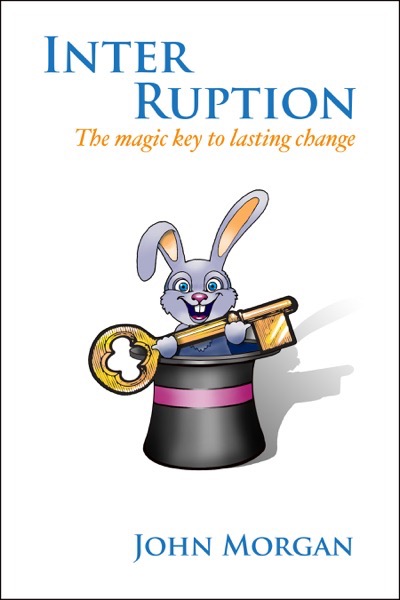
2. A year and a half ago, I self-published my book. It’s called, “INTER RUPTION: The Magic Key To Lasting Change.” I have decided to offer it as a FREE download to anyone who would like a copy. It’s in PDF form. It’s available here on the home page at https://grasshoppernotes.com
Happy reading and listening.
All the best,
John
 We’re caught in a trap of our own making when we believe we had nothing to do with how we got to our current station in life. It’s a blind spot.
It’s so easy to blame circumstance or someone else. I remember reading this James Allen quote from his 1903 book “As A Man Thinketh“: “Circumstances do not make the man, they reveal him.”
To quote The Grasshopper, “When someone is hiding a jackass, they send out a scapegoat.”
The mantra of the blind spot belief system is this: “It’s not my fault.”
Where you are now is the result of a recipe. If you retrace your steps, you will find the exact way you baked your cake. Whether it’s moist and delicious or has a burnt crust, it was your actions or inactions that produced your current circumstances.
We enjoy taking credit for the “good” things we’ve produced, but for the “bad” things, not so much.
We have conditioned ourselves to blame. It’s a coping mechanism we have learned to use when we don’t want to take responsibility for our actions. We’ve deflected so often that “this is not on me” becomes a fervent belief.
The quickest way to remove the blinders is to pretend that it is your fault. Sidebar: In most cases, you won’t be pretending. Just try on the mantle of responsibility more often than you do and you’ll recondition yourself to know “it’s on you.”
We all get ourselves into jams. The way out begins with acknowledging we had a hand in it. That admission keeps us from forever stalling with denials, and moves us more quickly to possible solutions.
You can continue to play the childhood game “Blind Man’s Bluff” and stay stuck, or recognize that it’s the mark of an adult to play the hand you dealt yourself.
All the best,
John
 The Grasshopper came up with a new description of fear: “Reacting to ‘what ifs’ instead of what is.”
There’s certainly enough fear going around these days but much of it is generated by reacting to what isn’t happening vs. what actually is.
Fear is almost always future based. “What will happen if . . . ?” is the operative mindset.
We project ourselves into the future but feel the fear now. That means even if what we fear does happen, we feel it way more than once.
We all fear but we can mitigate the frequency by focusing on what’s happening with us right now.
When we pay attention to what’s right in front of us, it keeps us from skipping over the present to fear the future.
Get in the habit of staying present. Even when doing routine things like washing you hands, pay attention to the experience: the feel of the soap in your hands, the warmth of the water, the feel of the drying towel, the sound of the water going down the drain.
When you give more attention to the present, you leave your future in the future and leave fear nothing to feed on.
Fear is a signal to pay attention and take some action. The action most needed is staying present.
There’s enough scary stuff to keep us fearful for a lifetime. But if you want to turn down the internal noise, pay more attention and you’ll regain your poise.
All the best,
John
 It seems to me that “Values” are universal and “What you value” is personal.
Values seem to be the unbendable law, and “what we value” bends toward our beliefs.
“Love thy neighbor” is universal; “Get off my lawn” is a reversal.
You have to be sightless not to see the tribal anger that is permeating our culture. That’s due in part to resistance to change. Society is always evolving but we don’t notice the change while it’s happening. It’s only after, when we read historic accounts, that we notice the building blocks that led to the change.
If you say, “This isn’t right,” you may want to ask yourself a question right after. That question is: “Is it not right because it violates values or is it not right because it violates what I value?”
Many of us value our preferences, predilections, and prejudices. If they don’t morph with the evolution of change, we’ll erect walls in order to stay the same. We will live in isolation with our tribe and be at war with anyone on the other side.
Values don’t change but what we value is adaptable. If we refuse to adjust, we’ll just continue to kick up dust and cloud the horizon so we can’t see the future.
Living in the past is the hallmark of “what I value.” The key to a more harmonious future is to start focusing on values now instead of corralling your sacred cow.
Look to nature for a clue. The rigid branch of a tree is the one that snaps. It’s the bendable branch that shapes its future.
All the best,
John
 The Grasshopper woke me up with this: “A counter thought is still thinking.”
He seems to be offering a prescription for not arguing with yourself.
First off, you have never won an argument with yourself, so there’s that. But secondly, the act of thinking keeps you from creating.
We are conditioned to believe that if we weigh the pros and cons in our head that we will come up with a creative solution. When has that ever happened?
Counter thoughts are just more thoughts. And if your mind is filled with thoughts, there’s no room for creativity.
Ah-ha moments don’t come from internal debates. Don’t take my word for it, just let the words of a great “thinker” sink in. Albert Einstein said, “We cannot solve our problems with the same level of thinking that created them.”
The next time you catch yourself gearing up for a debate, just notice the counter thoughts arising without engaging with them. Just the unemotional observation of these thoughts will dilute them, making space in your mind for something new to come through.
Let me leave you with this: The only “counter thought” that will serve you well is what kind of pie to order.
All the best,
John
 “Beyond the shadow of doubt” indicates in crystal clear terms that which is being asserted, is not a mere shadow of the truth.
Such is the case when we discover that we aren’t who we “think” we are. I’m of the opinion that if we distance ourselves from our thoughts about ourselves, most of our perceived problems will fade into the shadows.
Coming to the realization that we aren’t who we “made up and got comfortable with” is the passageway to becoming more authentic.
There isn’t a person among us who wouldn’t benefit by getting out from the shadows of our false self.
The process starts by un-labeling yourself. “I’m a mother, father, doctor, lawyer, Indian chief, or pole dancer” are assertions that need to be peeled away.
Once you stop describing yourself with nouns, you come closer to the you that can’t be named, yet is deeply felt.
Digging deep into the Tao te Ching – a 2500 year old Chinese philosophy – we find this:
The tao that can be told
is not the eternal Tao
The name that can be named
is not the eternal Name
The unnamable is the eternally real
Naming is the origin
of all particular things
I guess in modern terms this philosophy can be reduced to this: Don’t take yourself so seriously, otherwise you’ll become a shadow of yourself.
All the best,
John
 Just like footwear makes imprints in the snow, past events make imprints in our lives. Yet, trying to find those footprints after a new snowfall is as close to impossible as it gets.
Going back looking for what imprinted us is, at best, a history lesson. Looking for the cause, causes us to use the wrong pair of shoes. We don’t need ones that sink us deeper in the drifts, we need snowshoes – ones that facilitate walking forward, not descending into submersion.
I know some people who are in perpetual counseling. I wonder if they ever reflected on how going back over their cause keeps them mired in “because.”
“I’m this way because” is an abdication phrase that keeps us in a haze.
It may very well be true that past events cause you to react in a certain way now . . . until you notice. In the past, you’ve let your history handle you. It’s time now to handle your history. That means to notice it when it comes up as an excuse. And to quote The Grasshopper, “Excuses are like bad checks; they can’t be cashed.”
Start noticing your excuses for “why you are the way you are.” The more you notice them, the quicker they’ll go away, making way for sunnier days.
All the best,
John