


Coming and Going
 Thoughts that make you stand up and take notice come at the oddest times. Who carries a pen or pencil into the bathroom? “Have you no respect, Grasshopper?”
Here’s an outhouse offering from the cute little katydid: “You may not have had a choice in how a pattern came to you, but choice is the best choice for having it go away.”
Most of our patterns came to us accidentally. Think no further than your pattern of speech. You weren’t born with it; you acquired it, and that acquiring came without your knowledge or permission. Most people will have their pattern of speech, as broadcaster, Paul Harvey used to say, “From here to the hereafter.”
Some will want to change a lifelong pattern. They want it to go away in the worst way. As many have written, noticing is the first step in outgrowing a pattern. Here’s a secret most people don’t know: Patterns really don’t go away, they just get out of the way, so you can have the opportunity to make another choice. Perhaps an example would be helpful.
I don’t like rude people and I don’t like it when I act rudely. When I notice my rude behavior, I choose to set it aside so I can interact more effectively with others. But there are some rare times when being rude is the best choice. If you no longer owned the pattern, you wouldn’t be able to use it. Please trust me on this: Once acquired, we always own a pattern.
So after noticing our pattern in action, what do we do? We make another choice. It’s a simple concept but not easy to execute. That’s because patterns have a powerful lobbying group with the ability to rationalize anything.
Once you notice a pattern in action and wish to make another choice, you will get arguments to the contrary from this lobby group that would make famed attorney, Clarence Darrow cower.
What to do? Here’s what not to do: Don’t engage in a debate. You will lose and lose badly. You are outmanned and out gunned. What you can do is begin to notice the pattern of argument. Once you decide to make another choice, just watch and listen to the arguments to the contrary form. They will be eloquent and they will all be for keeping your pattern in place.
So not only do you have to notice the pattern of behavior you want to set aside, you also have to notice the arguments for keeping it in place. Once you get a bit of practice with your observations, you begin to get entertained rather than entrained by the arguments.
Few people like practicing; but when you make the choice to do so again and again, your patterns step aside giving you the ability to decide.
There’s an old Motown song called, “This Old Heart of Mine” which contains the lyrics, “You’ve got me never knowing if I’m coming or I’m going.” That’s the way you’ll feel when you don’t perceive you have a choice.
Final thought: Practice noticing and choosing and you’ll do a lot less losing.
All the best,
John
Be Sociable, Share!
 I woke up with the word, “Succinct” on my mind.
 “When you defend yourself too often, it’s offensive,” so said The Grasshopper yesterday.
 What are you married to? And, no, you don’t need a spouse to be married to something.
 The Grasshopper popped in on a phone call yesterday and had this to say: “If you always need something to be happy, you’ll always be needy.”
 The end of soon will not happen soon enough for me.
 The Grasshopper created a bumper sticker this morning: “Winners Choose, Reactors Lose.”
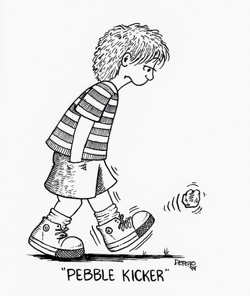 I was cleaning out a closet and found the picture you see in this post. I had someone draw it for my late teacher, Dr. Dave Dobson back in the 90s.
 There is an axiom in photography that goes something like this: The more open the lens, the less that’s in focus. Lenses that have the ability to open very wide are known as “fast glass.”
 The Grasshopper had me scrambling for a pen when he woke me up in the middle of the night with this: “Question your effort, never your worth.”