
GrasshopperNotes.com - Thoughts for inspired living


August 13, 2015

Managing the Moment

Filed under: John Morgan's Blog — John Morgan @ 6:49 am

Balancing actThe Grasshopper asked an interesting question yesterday: “Are you living in the moment or attempting to manage it?”

It immediately occurred to me that attempting to manage a moment takes you out of the moment and into a mind based scenario where you are trying to “get one over” on the moment.

Perhaps a parallel discussion about self hypnosis will illustrate the point. Most people think, including most hypnotists, that you get yourself into a hypnotic frame of mind and then give yourself some suggestions. The problem with that belief is the minute that you began to give yourself the suggestions, you would come out of the hypnotic frame of mind because a hypnotic frame of mind contains no thinking, just space between your thoughts.

It’s best to start your self hypnosis session with the goal you have in mind and then do your progressive relaxation. In other words, you set your intention before you go into your relaxed frame of mind, not after you’re there.

Back to the moment. The minute that you think something has to be managed in the moment, you’re no longer in it. Perhaps an example would be helpful.

Let’s pretend that you are having a conversation with someone. If you begin to think about what you’re going to say in response to what they just said, you have come out of the connection and retreated inside your head. You have come out of the moment and the communication will suffer.

To be in the conversation, you can’t come out of it. That means that your attention has to be given fully to what’s happening in the moment for you to stay in it. The minute you retreat, you are no longer in that moment.

Retreating from the moment is what I’m calling “managing the moment.”

Moments don’t need to be managed; they serve you best when they are experienced.

Being in the moment means to be with what’s right there, not with what’s on the horizon.

Being in the moment takes trust that you’ll know how to respond to whatever the moment has to offer, rather than coming out of the moment to search for a crafted response.

Staying in the moment takes practice because we have been highly conditioned to manage moments – meaning we are trying to control reality which is always a losing strategy.

Quoting my friend Jerry Stocking: “If we can’t be present to what we don’t want, then we aren’t likely to be present at all. Fair weather presence isn’t really presence at all, it is a dash of happiness on an absent canvas.”

All the best,

John


Be Sociable, Share!


August 6, 2015

Angry People

Filed under: John Morgan's Blog — John Morgan @ 6:46 am

AngryI have a confession to make: I am uncomfortable around angry people.

I’m not referring to someone who gets angry; that happens to all of us. I’m referring to the person who displays anger as their natural state of existence. These folks often don’t notice that they are angry.

Their anger sits below the surface but I notice it smoldering and start to feel uncomfortable in their presence.

I guess you could say, “that’s your issue, learn to deal with it.”

My programmed response is to want to help them to release the hold anger has on them by:

1. Noticing the anger.

2. Feeling it, rather than ignoring it, so it metabolizes.

That would be a heady mission to attempt to help all the angry people I come in contact with. Quite frankly, that’s unwelcomed and impossible.

Seems I have some options. I can just avoid their company (which is my current response) or I can attempt to help them (which I would need to ask their permission to do) or I could seek out ways to get more comfortable in their presence.

The last option has had me “managing people.” That means I would work at steering the conversation away from their angst. But like the Billy Joel Song says, “I don’t want clever conversation. I never want to work that hard.”

I have this anticipated fear that at any moment their torrent of anger will be released which would just add to my discomfort.

My experience with that scenario in the past has been to confront them about their behavior which generally leads to escalation rather than resolution. I add to the fire rather than douse it.

I guess my best option is to take my own advice (who ever does that?) and notice my discomfort and feel it fully so that it dissipates.

I’ll let you know how I make out. If you ever see me at an anti-government rally, you’ll know I’m working on my issue.

All the best,

John


Be Sociable, Share!


August 5, 2015

Lip Service

Filed under: John Morgan's Blog — John Morgan @ 4:24 am

Hostess ho hos“Lip service is the hallmark of inaction.” That’s what The Grasshopper offered in response to an email I got from a concerned parent regarding his son’s drug abuse.

Admitting you have a problem is part of all formal drug counseling. The rub is that many abusers use admission as evidence that they’re doing something about it. Announcing on Facebook that you have a problem is a far cry from actually addressing the issue.

Announcing that you have a problem with “Hostess Ho Hos” is a canard many abusers use to divert peoples’ attention away from the fact that they’re still devouring them in large quantities. It’s a stalling tactic.

Admission has to be followed by action. If it’s not, you have lip service.

Pay attention to what people do more than what they say and you’ll have a better barometer on what will happen at the end of the day.

Don’t debate peoples’ words; challenge their inaction. It will get one to focus on the core of the matter much quicker.

Lip service is like dog shit; it’s everywhere. It’s up to you whether you’ll announce that you’ve stepped in it again or take some action and clear it from your path.

All the best,

John


Be Sociable, Share!


July 29, 2015

Human Nature

Filed under: John Morgan's Blog — John Morgan @ 7:05 am

Baseball Pitcher“When it comes to human nature, there are as many mysteries as there are revelations.” So said The Grasshopper yesterday.

It seems the essence of the message is that “people will surprise you.”

That should come as no surprise.

We have been attempting to classify people from the dawn of time. There are many personality models that have surfaced over the years – too many to mention – and they all tend to want to sum us up in a sentence.

I find these personality typing systems helpful in a global sense. They help me quickly home in on the personality I’ll be interacting with. They get me in the ballpark. But after that, it becomes a bit more unpredictable.

That’s when the ability to respond comes into play. That means we can’t remain on a step-by-step path when another steps out of character. If we do, the interaction comes to a halt and there is no communicating going on.

Reminds me of an old talk show technique. Pretend that you have a guest that you haven’t prepared for and their topic is one you’re not familiar with. After you introduce them and ask your first general question or two, you then go to what I call “the last sentence mode.” That means that you formulate a question on the last thing they said. “Yes, this car of the future comes with a 4 barrel ashtray.” “So, I’m sure our viewers/listeners are curious, what is a 4 barrel ashtray?”

This keeps the communication going as you respond to each new surprise.

People won’t always react the way your preferred typing system predicts they will. When they throw you a curve ball, that’s when to throw away the manual and reach for a response. That means you’ll have to let your conditioned reaction go by so you don’t swing and miss. When you recognize the curve, wait for a response that’s not pre-programmed and offer it instead. It keeps the communication going and prevents it from devolving into chaos.

Responding keeps you flexible. You’ll succeed more often when communicating with others when you opt out of rigid reactions and offer flexible responses instead.

Dr. Dave Dobson told his students to respond to a critical remark (a surprise) in this fashion:

1. Ask a question in response to the remark.

2. Ask with genuine curiosity.

3. Ask the question in “neutral.” (That means to take the implied “screw you” out of your voice).

This allows the communication to keep going and gives you a much better chance for a productive outcome than had you offered your initial reaction.

I don’t think the mystery of human nature will ever be solved, so when a person puzzles you, make sure to respond.

All the best,

John


Be Sociable, Share!


July 28, 2015

Adaptation

Filed under: John Morgan's Blog — John Morgan @ 7:20 am

ThBroadcastere Grasshopper offered this little sprig of mint for my mental iced tea: “Adaptation is a catalyst for continued creation.”
The alternate message seems to be that when we don’t adapt, we get stuck in stale. Creativity comes to a halt.

Creativity isn’t linear. We seem to want a formula – 7 steps. From my experience, creativity doesn’t work that way. In fact, the steps seem to get in the way because we forget to adapt to changing circumstances the current steps don’t fit.

I’m a photography buff and I’ve heard this exact same suggestion from a number of landscape photographers. If the scene you’ve decided to take a picture of just isn’t looking good to your eye, turn around and look behind you. There may be a previously unnoticed gem just waiting for you. That’s adaptation spurring potential creativity. Many will continue to photograph the first scene over and over again, getting the same unsatisfying results.

Failure to adapt will give you a steady diet of brick dust.

It’s like the basketball coach who inherits a team that is highly adept at playing at a very fast pace and attempting to fit them into his model of slowing the game down. He doesn’t adapt to what he has and is totally surprised when he doesn’t win.

I have an expression I use for those who don’t adapt: “One Speed.”

Here’s a story I’ve told before: I worked with this fast talking, high volume DJ when I was a broadcaster. He did the best concert commercials with his patented delivery but you had to hear the commercial he did for the funeral home; it was comical. He didn’t adapt to the material and his creativity was cut off by his cookie cutter approach.

Life is filled with choice points. If we continue to make the same type of choices at each crossroad, we have ignored adaptability and shut down our creativity. “How did I wind up here again?” is easily answered by pointing out our failure to adapt.

Choice points are an opportunity to create something new. If we don’t adapt to the circumstances, we keep our creativity encased in glue.

All the best,

John


Be Sociable, Share!


July 27, 2015

30 Seconds

Filed under: John Morgan's Blog — John Morgan @ 6:21 am

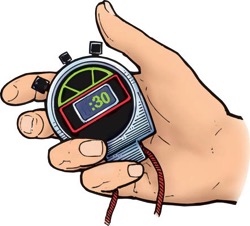
StopwatchPretend you have the opportunity to communicate with anyone living or dead but you only get 30 seconds to say what you want.

There are no questions involved, only statements. The person is only there to hear your message. What would you say in 30 seconds? What do you want them to know?

30 seconds is all you get, so make sure everything you want to say gets prioritized within that time frame. It may take you a lot longer than 30 seconds to come up with what you want to say. That’s OK. It’s the prioritization of the information that delivers the benefit.

You will find out, for sure, exactly what that person means/meant to you. It will no longer be a hodgepodge of information pulling you to and fro, just a capsulized message you want them to know.

What is the benefit? Even though they may never hear it, the benefit to you lies in crafting and delivering your message in 30 seconds. It will clear out your mind and open your heart.

Why 30 seconds? It reminds me of a story I’ve told before . . .

My friend Paul uses this technique for his public speaking class. He asks students to imagine that they’ve been selected by the Today Show to do a live interview with their favorite singer/actor/sports hero, etc. They are asked if they could come up with enough questions to fill a 5 minute segment and they all answer “yes.”

He then asks them to imagine that they are 30 seconds from air time and the producer says into their earpiece that they will now only have 1 minute for the interview because they are going to have to cut away to cover a big, breaking news story. Now they have to rearrange their questions so that they can make sure they ask the most important one.

This is a powerful exercise, especially if you have to excise some unfinished business from your psyche. Going past 30 seconds turns it into drama, so make sure to adhere to the allotted time. Pretend the person is there and say your 30 second message aloud. It has the real possibility of getting you out from under a long, lingering cloud.

All the best,

John


Be Sociable, Share!


July 21, 2015

Imagination

Filed under: John Morgan's Blog — John Morgan @ 7:37 am

Frog Lily pondI was listening to celebrity photographer Jeff Kravitz being interviewed yesterday and in there he offered this piece of wisdom: “We’re all figments of our imagination.” He followed that up with a question: “So then, why not imagine big?”

Most of us play small ball based on the image of ourselves that we made up and got comfortable with. It’s that image that keeps us confined to wherever we imagine we belong.

Updating your image of yourself is the first step in getting the horse out of the barn. It’s an interesting exercise to see yourself differently than you imagined. It does take off the blinders and opens you to a bigger world.

It may seem counter-intuitive on first blush, but it seems to me that the next evolutionary step is to rid ourselves of any image whatsoever. If all our images are figments anyway, there’s no sense hanging on to anything false, no matter how big it is.

This process is more difficult than updating your image but the benefits are exponentially better than any image you hold of yourself.

The process begins when we start to own the realization that we are not any image, no matter how tarnished or polished it is.

The benefit to this is that we don’t have to pretend any longer. Pretending takes a lot of effort and that is draining. When we drop the pretense of any image, we breathe easier and get more comfortable in our own skin.

You may like or dislike labels that you or someone else has ascribed to you, but when you start peeling them off one-by-one, you get to the core of who you are which can’t be labeled, only experienced.

Harkening back to a Grasshopper blog post from five summers ago:

Who you are cannot be named. It’s like the ancient Chinese philosopher, Lao-Tzu reminded us in the opening verse of the Tao Te Ching: “The Tao that can be explained with words is not the Tao.” The verse goes on to say, “We desire to understand the world by giving names to the things we see, but these things are the effects of something subtle. When we see beyond the desire to use names, we can sense the nameless cause of these effects.”

In our trip across this pond called life, there are certain lily pads we have to get to first before we can get to the next one. Realizing you can change your image in this “frog into prince/princess” journey is the first step. The next leap before we can get to the other side is to land on the idea that we are neither a frog nor a prince. This allows us to experience the essence that makes up all labels, so we don’t have to get stuck on one.

Use your imagination and find out you are more than any label you can dream up. Quoting the photographer again, “Why not imagine big?”

All the best,

John


Be Sociable, Share!


July 20, 2015

Respect

Filed under: John Morgan's Blog — John Morgan @ 6:20 am

Cover170x170Here’s one of the struggles I have in life: offering respect to someone who doesn’t offer it to themselves.

I realize that “respect” is a fluffy word, meaning it has different meanings to different people. Here’s what it means to me: recognizing something as a treasure and treating it that way.

There are no perfect people and we all have flaws. It’s when we accentuate one of those flaws and maximize it that disrespect comes into play, at least for me.

I’m sure we can all think of a time we acted rudely. Perhaps we were having a bad day and reacted poorly. If it’s an infrequent occurrence, we can give ourselves a pass. If it comes up as often as the sun, we’re being disrespectful of others.

If you’re consistently doing something to the detriment of your physical or mental well-being, you’re being disrespectful to yourself.

Again, I recognize this as my struggle. I’m searching for the milk of human kindness but haven’t yet found it for a person immersed in disrespect.

Generally I find this type of person either doesn’t recognize or denies being disrespectful.

If, after becoming aware of their level of disrespect, they choose to ignore it, they become part of the denying crowd. The deniers make up the bulk of the people I find disrespectful, especially to themselves.

I recognize not finding respect for these folks is my flaw and I can only tell you it’s a work in progress for me.

I’ll let you know how I make out. Perhaps if I play the Aretha Franklin song on repeat on my iPhone, I’ll get what I claim I don’t deserve – R-E-S-P-E-C-T.

All the best,

John


Be Sociable, Share!


July 14, 2015

Are You Relevant?

Filed under: John Morgan's Blog — John Morgan @ 6:12 am

Lone WolfWhat a great question to ponder – “Are you relevant?”

Before I could answer it for me, I had to look up the definition of “relevant.” It read, “closely connected to the matter at hand.”

Seems if we’re not closely connected to whomever or whatever, that makes us irrelevant. That makes sense to me.

Connection is the key to relevancy.

“How many ways are we disconnected?” is another question worth pondering in our quest to know how relevant we are.

Another way of asking that same question is: “How many areas of your life have you checked out of?” The answer to that question will give you a precise answer on your relevancy.

It seems that if you want to be more relevant, you have to check in more.

Relevancy takes some work. It’s not a gift given to us; it’s a wage that has to be earned no matter what our financial status.

Channeling my inner Oprah, here’s what I know for sure: The more I check out, the more irrelevant I become. That means that I cannot blame any notion of “woe is me” on anyone but me, especially if I stopped accepting invitations for tea.

The conversation stops being about you soon after you check out. The longer you stay there, the more irrelevant you become.

Want to be more connected, more relevant? Start checking in. It’s the key to being close at hand.

All the best,

John


Be Sociable, Share!


July 9, 2015

When Help Isn’t Helpful

Filed under: John Morgan's Blog — John Morgan @ 6:58 am

Know it allI had this phrase pop in my head the other day: “Your input isn’t going to change him.”

I was working with a pretty knowledgeable fellow helping me select a custom designed product for me. There was testing involved so that this product would fit my needs to a “T.” It was a 2-hour process.

The difficulty I was having was not with his information but with his style of delivery. He had one speed and it wasn’t the speed at which I was traveling.

Part of his job was being an expert and part of his job was sales. He will be commissioned on the product if I purchase it.

Basically, he was throwing up on me. That means he was coming at me with non-stop information and he rarely stopped to breathe. He wasn’t allowing me to process the information. I purposely interrupted him a number of times so that I could get a break from his machine gun delivery. He also lacked sensory acuity. That means he wasn’t paying attention to see if his message was being received.

After the session, I was tempted to “help him out.” After all, that’s what I’ve done my entire career – help people make changes.

As I was about to offer my “wisdom,” I got the gift of awareness that my input wasn’t going to help him. In the past, I would have tried to be like the story of Jesus going after the lost lamb.

People may benefit from the help you provide but if it’s not going to register with them, what’s the point? You don’t need the practice and to quote my teacher Dr. Dave Dobson, “They aren’t paying you.”

I could have helped improved this fellow’s delivery and his sales skills in a matter of minutes if he was open to it, but I could tell he wasn’t and, frankly, he wasn’t asking.

I guess the lessons I learned are these: If my intent is to tell someone what I know that they don’t, I will not be helpful to them. It smacks of superiority and will fall on clogged ears. Even if my intention was to just plain help them, I wouldn’t be successful with someone who doesn’t believe they need any or want any.

Generally what I find is this: The person who is the hero of their own stories isn’t going to be open to your assistance. The person who “talks in a trance” (doesn’t notice that you’re there while they’re talking) won’t be open to your help. The person who is an expert on everything, yet has nothing to show for it, will be closed off to any helpful input you may have.

Think of helping in this way: Pretend you’re a professional golfer at a driving range and you see a father giving bad coaching to his young son on how to swing the club. If you step in and offer unsolicited help, you most often will be treated as a pariah even though your expertise is far “superior.”

Best to lend a hand in these situations only when help is requested, otherwise your help won’t be helpful.

All the best,

John


Be Sociable, Share!


« Previous PageNext Page »